One in three of your gym members is quitting this year. You just don’t know which ones yet.
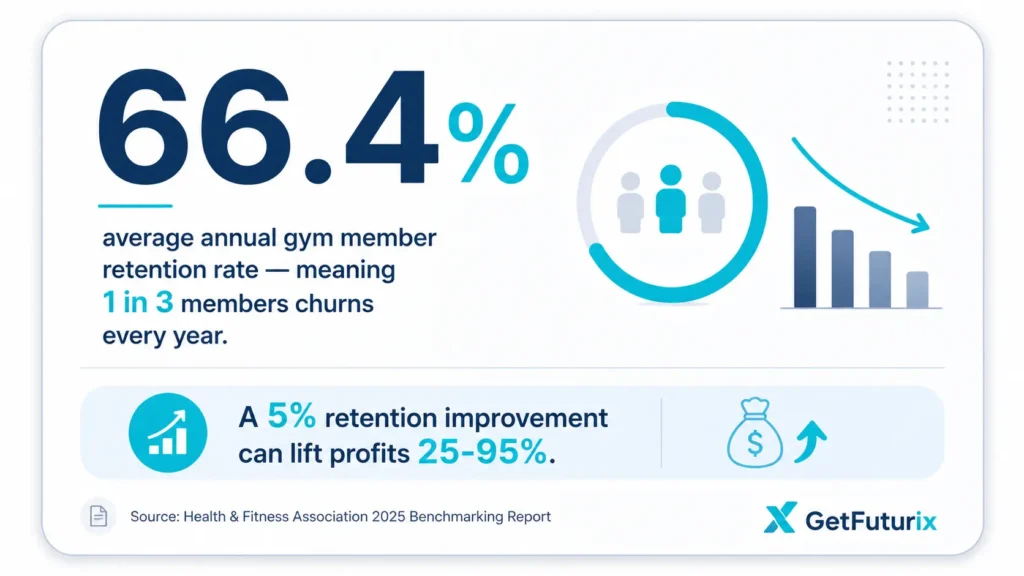
The industry-average annual retention rate for gyms sits at 66.4%, according to the Health & Fitness Association’s 2025 Benchmarking Report across 175 fitness companies. That means roughly a third of your membership base is walking out the door before December — and most of the warning signs show up weeks before anyone actually cancels.
This guide covers AI tools for gym owners and personal trainers that genuinely address that gap — split honestly by who you actually are, because a gym owner managing churn and a solo trainer managing client programming need very different tools.
Table of Contents
Why Retention Is the Real AI Opportunity in Fitness
Most content about AI tools for gym owners and personal trainers jumps straight to fancy workout apps. That’s not where the money actually is.
A 5% improvement in member retention can lift profits by 25% to 95%, depending on your business model. Compare that to chasing new leads — acquiring a new member costs significantly more than keeping an existing one happy, and most of the churn happens quietly, in the first 90 days, long before anyone fills out a cancellation form.
Trainers see the same math on their own book of clients. Reducing monthly client churn from 8% to 5% compounds dramatically over a year — the difference between a training business that grows steadily and one that’s constantly refilling a leaky bucket with new sign-ups.
AI Churn Prediction for Gyms: Spotting the Warning Signs Early
Here’s the part that actually works, and it’s more rigorous than most gym owners assume.
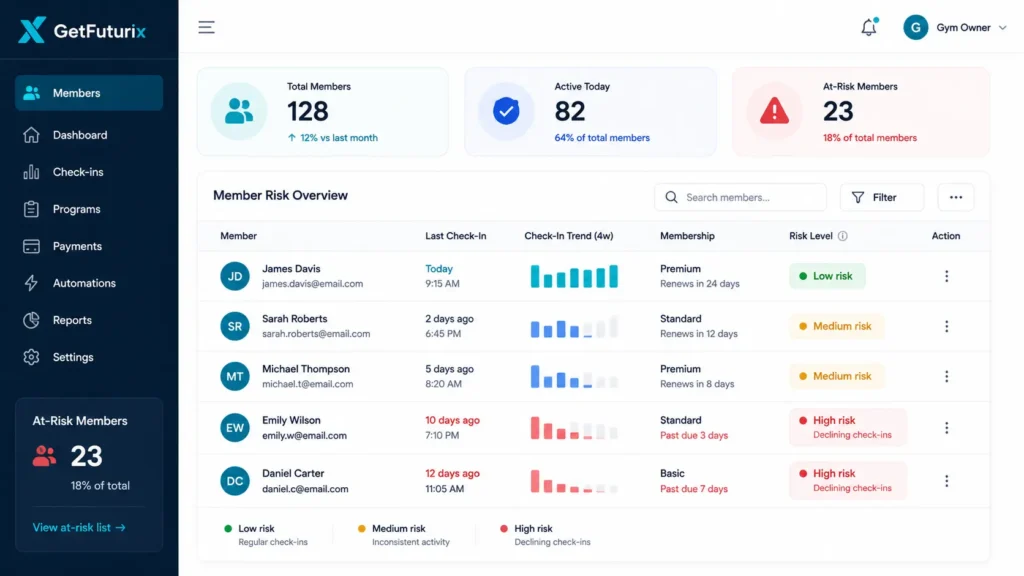
AI churn prediction gym tools analyse behavioural signals — declining check-in frequency, missed classes, slower response to messages, stalled progress — and score each member’s cancellation risk before they’ve made the decision themselves. This isn’t guesswork. One peer-reviewed study using a Gradient Boosting model achieved 95.5% accuracy predicting dropout across a 5,209-member dataset, using nothing more than attendance, billing, and tenure data most gyms already collect.
The practical output looks like a simple risk tier: low, medium, high. A member sliding from three visits a week to zero over three weeks gets flagged automatically — long before the front desk would ever notice on its own, buried in the daily rush of check-ins and class schedules.
Prediction alone isn’t the finish line, though. The real value only shows up when a flagged member actually gets a genuine check-in call, message, or offer — not just a number sitting unread in a dashboard. The gap between a risk score and someone actually reaching out is where most of the missed opportunity lives.
AI for Gym Member Retention: Beyond Just Prediction
Churn isn’t one problem. It’s at least two, and they need different fixes.
Voluntary churn is a member actively choosing to leave — cost, low usage, finding a free alternative. Industry data puts these as the top three reasons members cancel, in that order. AI for gym member retention tackles this through automated, personalised outreach the moment disengagement signals appear, rather than a generic monthly newsletter nobody reads.
Involuntary churn is different and, frankly, more fixable. Failed payments drive roughly one in three gym cancellations — not because the member wanted to leave, but because a card expired and nobody followed up. AI-optimised billing recovery tools now achieve collection rates approaching 98% by retrying payments at smarter times and following up automatically, rather than losing that member to a silently declined transaction.
This distinction matters because it changes where you spend your effort. A member who’s genuinely disengaged needs a different conversation than one whose card simply expired. Treating both the same way wastes the exact moment where intervention actually works.
→ See also: AI Tools for Salon Owners 2026: Book More Clients With Less Work
AI Workout Programming Software for Personal Trainers
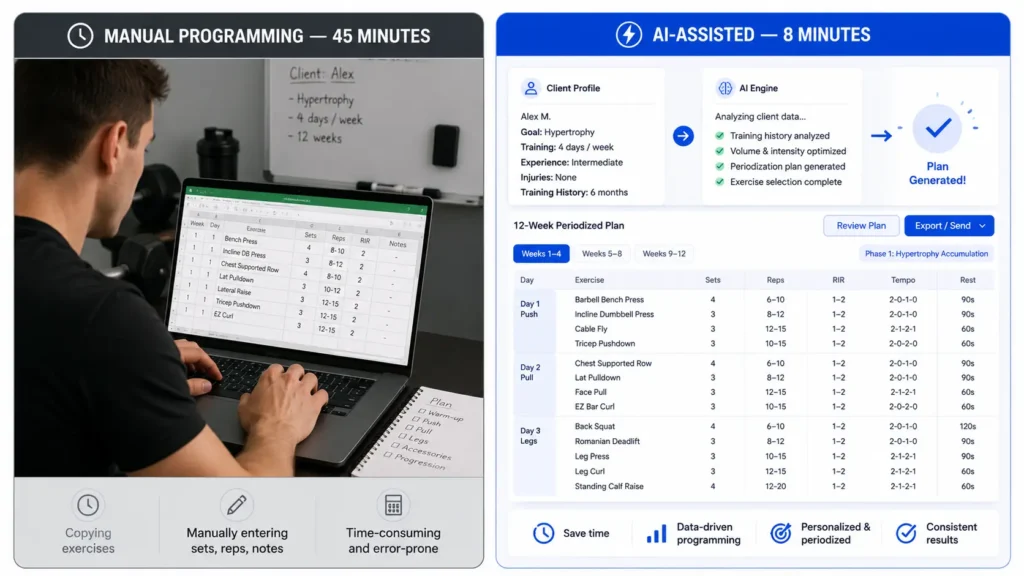
If you’re a solo trainer rather than a gym owner, this is where the real time savings live.
Building an individualised programme by hand — periodisation, progression, adjusting for each client’s equipment and limitations — genuinely eats hours every week. AI workout programming software now handles the first draft of that work, generating a structured plan from a client’s goals, history, and available equipment in minutes rather than the better part of an hour.
This isn’t about replacing your programming judgment. It’s about not starting from a blank page every single time. A trainer who cuts programming time in half doesn’t just save hours — they can take on more clients, follow up more consistently, and actually spend more time coaching on the floor instead of hunched over a spreadsheet after hours.
AI personal trainer software in this category also increasingly tracks the follow-through — workout completion rates, streak data, progress trends per client — surfacing who needs attention without you manually reviewing every single profile before every single session.
ChatGPT for Personal Trainers: The Free Starting Point
You don’t need dedicated software to start seeing value here. ChatGPT for personal trainers covers a genuinely useful slice of this work at zero cost.
Paste a client’s goals, current fitness level, and available equipment, and ask for a structured 4-week programme with progression built in. It won’t replace a purpose-built platform for tracking dozens of clients long-term, but for drafting a starting-point programme, writing client check-in messages, or building nutrition guidance templates, it removes the blank-page problem entirely.
The practical combination most solo trainers land on: ChatGPT for drafting programmes and client communication, paired with a dedicated tracking app once client volume justifies the subscription cost.
→ See also: How to Use ChatGPT for Beginners: The Complete Guide
Comparing Tools by Gym Owner vs Personal Trainer Needs
Not every tool fits every role in this industry. Here’s the honest breakdown by who’s actually using it.
| Category | Best For | Free Option? | Real Impact |
|---|---|---|---|
| AI churn prediction | Multi-location gyms, studios | Rarely — usually bundled in gym software | Flags at-risk members weeks earlier |
| AI billing recovery | Any subscription-based gym | Rarely — vendor-specific | Recovers involuntary churn from failed payments |
| AI workout programming | Solo personal trainers | ChatGPT free tier covers basics | Cuts programme-building time significantly |
| AI client progress tracking | Trainers with 15+ active clients | Some free tiers exist | Surfaces who needs attention automatically |
| ChatGPT | Both — comms, drafting, planning | Yes, fully free | Removes the blank-page problem entirely |
The realistic starting point depends entirely on your role. Gym owners should look first at churn prediction and billing recovery — that’s where the retention math is strongest. Solo trainers get more immediate value from programming automation, and ChatGPT is the free way to test that before paying for anything dedicated.
What AI Won’t Fix in a Gym or Training Business
Being honest about the edges here, because this space oversells itself constantly.
AI flags the risk. It doesn’t have the conversation. A churn prediction score is only useful if a real person follows up with a genuine check-in — the algorithm identifies who to call, not what to say or how to actually make someone feel valued.
No algorithm replaces the coaching relationship. The motivation, the form correction, the trust built over months of sessions — that’s still entirely you. AI handles the administrative weight so you have more time for that relationship, not less need for it.
A tech-forward member experience isn’t a substitute for community. Members with social ties to a gym consistently stay longer than those training in isolation. AI can support that community. It can’t manufacture it from a dashboard.
Frequently Asked Questions About AI Tools for Gym Owners and Personal Trainers
Q: What AI tools should a small gym owner start with?
A: Start with AI churn prediction if you’re losing members you didn’t see coming, and AI billing recovery if failed payments are a recurring problem — since failed payments alone drive roughly one in three gym cancellations. AI tools for gym owners and personal trainers at this level typically come bundled inside gym management platforms rather than as standalone free tools, so check what your existing software already offers before buying something new.
Q: How accurate is AI at predicting gym member churn?
A: Genuinely accurate when built on real behavioural data. A peer-reviewed study using a Gradient Boosting model achieved 95.5% accuracy predicting member dropout across a dataset of 5,209 members, using attendance, billing, and tenure signals most gyms already collect. AI churn prediction gym tools work by flagging declining engagement patterns weeks before a member actually cancels — the harder part is making sure someone actually acts on the flag.
Q: Can ChatGPT replace dedicated personal trainer software?
A: Not fully, but it covers real ground for free. ChatGPT for personal trainers works well for drafting workout programmes, writing client communication, and building nutrition guidance templates. It doesn’t track long-term client progress across dozens of profiles the way dedicated AI personal trainer software does — most solo trainers use both together as client volume grows.
Q: What’s the difference between voluntary and involuntary gym member churn?
A: Voluntary churn is a member actively deciding to leave — usually driven by cost, low usage, or finding a free alternative. Involuntary churn happens when a payment fails and nobody follows up, even though the member never actually chose to cancel. AI for gym member retention needs to address both separately, since a disengaged member and an expired card require completely different responses.
Q: Is AI workout programming software worth it for a solo personal trainer?
A: Usually yes, once you’re managing enough clients that manual programming eats a significant chunk of your week. AI workout programming software generates a structured first draft based on client goals and history in minutes rather than the better part of an hour — freeing up time for the coaching and relationship-building that actually retains clients long-term.
Q: How much does gym management software with AI features typically cost?
A: It varies significantly by gym size and feature set, and most vendors price around member count or number of locations rather than a flat fee. Gym management software AI features like churn prediction and billing recovery are increasingly bundled into existing platforms rather than sold separately, so the real first step for AI for small gyms 2026 is checking whether your current software already includes tools you haven’t turned on yet.
Start With the Members You’re Already Losing
You don’t need every tool on this list running by next week.
Pull up your own numbers first. How many members have gone quiet in the last 30 days without anyone reaching out? How many failed payments turned into silent cancellations instead of a follow-up call? That’s where the real opportunity is sitting right now.
AI tools for gym owners and personal trainers work best when matched to the specific leak in your business — not the most impressive feature on a sales page. Start with retention. Add programming automation if you’re a trainer buried in spreadsheets. Build from there.
Want more practical AI guides for small business owners? Browse our full library at GetFuturix.com.
Related articles on GetFuturix: