Nearly half of what AI tells you has a real problem hiding in it. And it sounds completely confident while doing it.
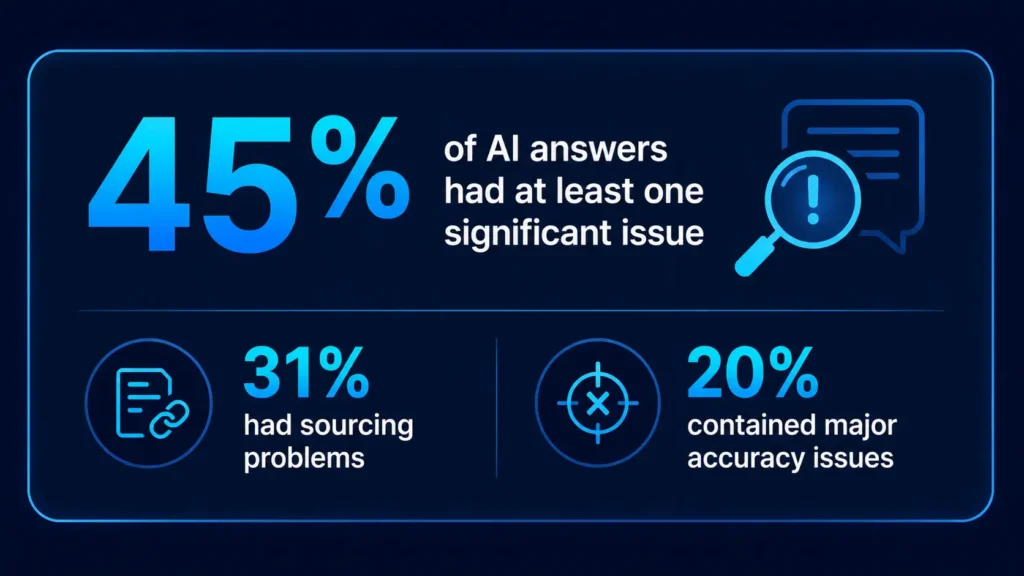
A 2026 study from the BBC and the European Broadcasting Union, built on input from 22 media organisations, found that 45% of AI answers had at least one significant issue. Not typos. Real problems. 31% had sourcing errors — wrong attributions, broken links, missing citations. 20% contained major accuracy issues, including facts that were simply invented.
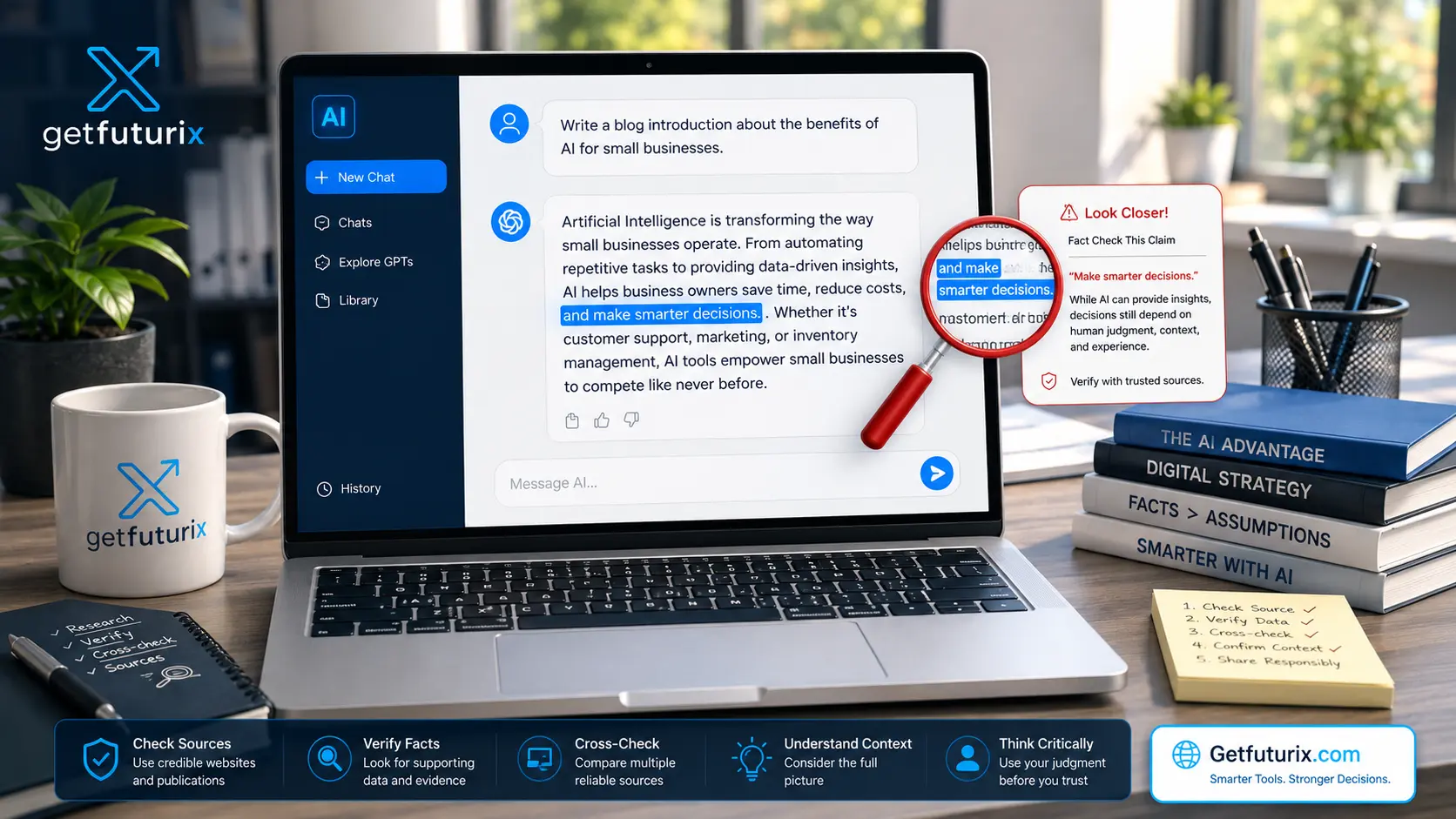
That is the gap this guide closes. Learning how to fact check AI writing is not optional anymore if you publish anything AI helps you draft — a blog post, a client email, a report, a product description. Here are five free methods that actually catch the errors before your readers do.
Table of Contents
Why AI Sounds Certain Even When It’s Wrong
Here’s the part that trips people up: AI is not lying to you. It doesn’t know the difference between true and made up.
A language model predicts the next most likely word based on patterns in its training data. It is not checking a database of verified facts. It’s an extremely powerful autocomplete, and autocomplete has no built-in sense of truth.
This is why AI hallucination — the technical term for confidently invented information — happens across every model, every task, every day. Stanford’s 2026 AI Index tested 26 top models and found hallucination rates ranging from 22% up to 94%, depending on the benchmark and how the question was framed. Even the best-performing models still make things up at measurable rates. None of them are at zero.
The most dangerous part isn’t the error itself. It’s the tone. A hallucinated statistic reads exactly as confident as a real one. That is precisely why how to verify AI generated content has become a skill every writer needs now, not a nice-to-have.
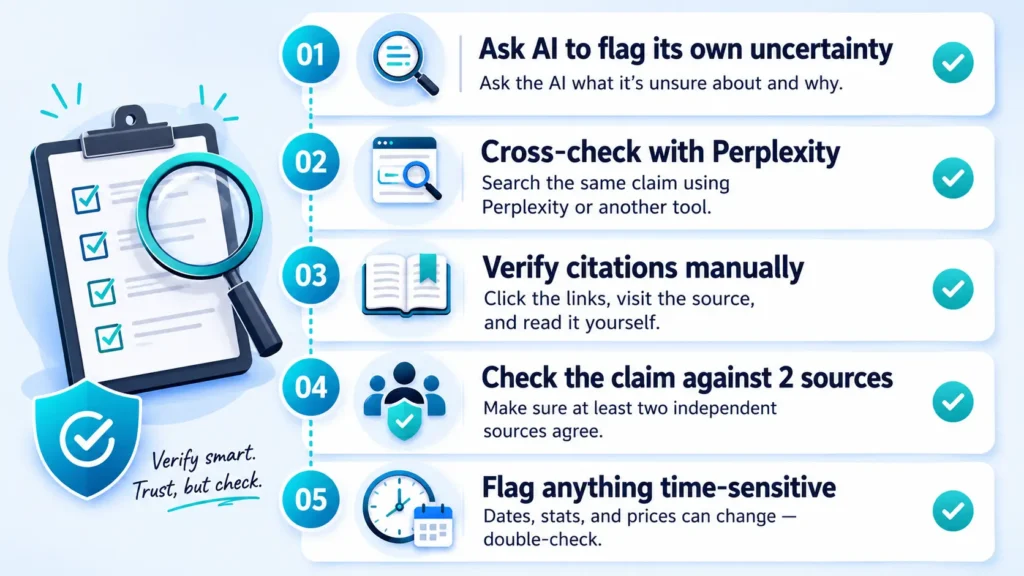
Method 1: Ask the AI to Flag Its Own Uncertainty
This one takes ten seconds and catches more than you’d expect.
After you get a response, ask directly: “Which parts of this answer are you least confident about? Flag anything you’re not certain is accurate.” This forces a second pass, and models frequently walk back a claim they stated confidently the first time.
One caveat worth knowing: this trick works best in the same conversation, right after the original answer. Google researchers found that asking a model “are you hallucinating right now?” measurably reduced errors in the next few responses — but the effect fades after five to seven more exchanges. Use it immediately, not as an afterthought three messages later.
This is not a complete fix. Treat it as your first filter, not your last line of defence.
Method 2: Cross-Check With a Search-Grounded AI Tool
Not every AI tool works the same way, and that difference matters here.
ChatGPT’s standard responses draw from training data and pattern prediction. Perplexity AI, by contrast, searches the live web and shows you exactly which sources support each claim. Take the specific fact or statistic your first AI gave you and ask Perplexity the same question directly.
If Perplexity can’t find a source backing the claim, that’s your red flag. This single step catches a huge share of fabricated statistics, invented studies, and misattributed quotes — because grounded search tools cannot invent a source the way a pure language model can.
This is genuinely the fastest high-value step in ChatGPT fact checking for anyone publishing content regularly. Two tools, one quick cross-reference, and you’ve filtered out most of the obvious fabrications.
→ See also: How to Use ChatGPT for Beginners: The Complete Guide
Method 3: Verify Every Citation Manually
This is the method that catches what everything else misses, and it’s the one people skip most often because it takes real minutes, not seconds.
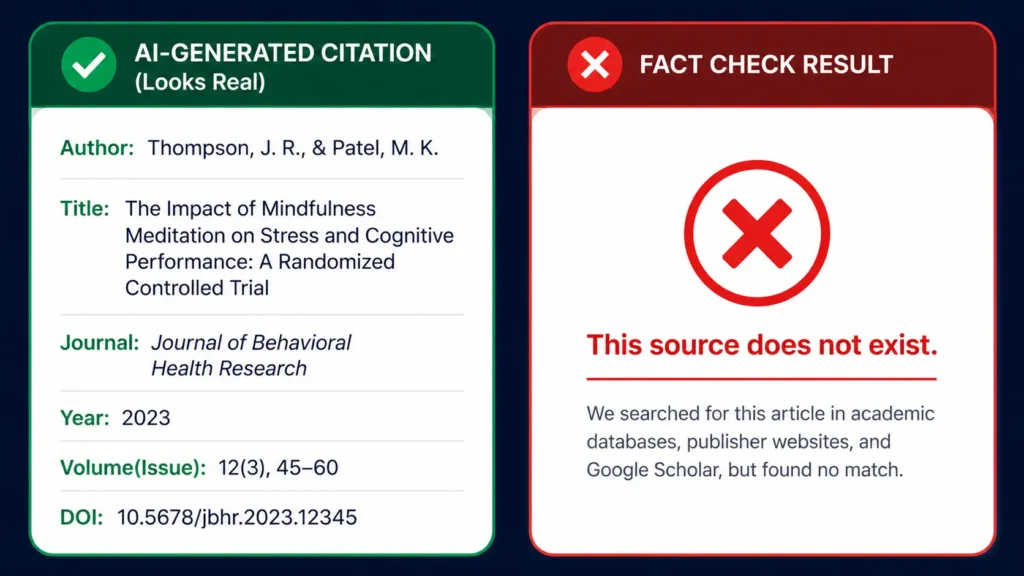
Researchers at GPTZero found that hallucinated citations “seem plausible on first glance and require high levels of technical expertise or time-intensive research to identify.” An invented DOI looks exactly like a real one. A fabricated author name sounds exactly like someone who could exist. That is what makes this failure type so dangerous — it doesn’t look fake.
How to check AI citations properly: copy the exact author name, title, and publication into Google Scholar or PubMed and search it directly. If nothing comes up, or if a similar-sounding paper exists but doesn’t say what the AI claimed, you’ve caught a fabrication.
This matters more than ever right now. In May 2026, arXiv announced that authors submitting papers with unchecked AI-generated content — including hallucinated citations — could face a one-year submission ban. That is how seriously the research world now treats this exact problem.
Method 4: The Two-Source Rule for Any Specific Claim
Simple rule, easy to forget under deadline pressure: any number, date, or named fact needs two independent sources before it goes in your published content.
Not two AI tools asked the same question — actual independent sources. A stat AI gives you, checked against one original report or dataset. If you can’t find that second source within a few minutes of searching, the claim doesn’t go in the article. Full stop.
This single habit would have caught most of the errors in the BBC/EBU study. 31% of AI answers had sourcing problems specifically because nobody traced the claim back to where it supposedly came from. The two-source rule is not glamorous. It is just the thing that actually works.
Method 5: Flag Anything Time-Sensitive or Numerical
AI models have a training cutoff, and they don’t always know it — or admit it clearly.
Prices, statistics, current job titles, recent events, and anything described as “the latest” or “as of now” carry the highest risk of being outdated rather than fabricated. This is a different failure mode from hallucination, but it’s just as damaging if you publish it as current.
Before publishing any number or date-sensitive claim, do a fast manual search for the same fact with the current year in your query. If you find a different, more recent number, that’s the one that goes in your article — not the one the AI gave you with total confidence.
Comparing the Five Methods: Speed vs Reliability
Not every method fits every situation. Here’s how the five stack up when you’re deciding where to spend your time.
| Method | Time Required | Catches | Best For |
|---|---|---|---|
| Self-flag prompt | 10 seconds | Model’s own known weak spots | Quick first-pass filter |
| Perplexity cross-check | 1–2 minutes | Fabricated stats, invented studies | Any factual claim before publishing |
| Manual citation check | 3–5 minutes | Fake academic sources, invented DOIs | Research-heavy or academic content |
| Two-source rule | 2–5 minutes | Sourcing errors, unverifiable claims | Every number or named fact |
| Recency check | 1–2 minutes | Outdated info presented as current | Prices, stats, current events |
The realistic workflow for most content: run the self-flag prompt immediately, Perplexity cross-check every factual claim, and reserve the manual citation check for anything genuinely research-heavy. Stack two or three of these rather than relying on just one — fact checking pipelines that combine methods catch measurably more errors than any single check alone.
What These Methods Won’t Catch
Being straight about the limits here, because overselling this defeats the purpose.
No automated tool is perfect. Even the best hallucination detectors treat their output as a prioritised list of what to double-check, not a final verdict. Human judgment still has to close the loop on anything genuinely high-stakes.
Domain matters enormously. Legal AI tools have been found to hallucinate in 17% to 34% of challenging research queries, even purpose-built ones. Medical summarisation carries similarly serious risk. If you’re writing about medicine, law, or finance, the bar for verification is higher than a casual blog post.
Subtle misgrounding is the hardest failure to catch. This is when an AI cites a real source that simply doesn’t support the specific claim being made. It looks completely legitimate on the surface. The only real defence is actually reading the source yourself, not just confirming it exists.
None of this means avoid AI writing tools. It means treat every factual claim as a draft, not a fact, until you’ve checked it yourself.
Frequently Asked Questions About Fact Checking AI Writing
Q: How do I fact check AI writing before I publish it?
A: Run through the five methods in order of speed: ask the AI to flag its own uncertain claims, cross-check any statistic with a search-grounded tool like Perplexity, manually verify citations through Google Scholar, apply the two-source rule to every specific fact, and flag anything time-sensitive for a recency check. Learning how to fact check AI writing properly means stacking two or three of these rather than trusting a single pass.
Q: How often does AI actually hallucinate facts?
A: More often than most people assume. Stanford’s 2026 AI Index found hallucination rates ranging from 22% to 94% across 26 top models, depending on the specific benchmark and task. A separate BBC and European Broadcasting Union study found 45% of AI answers had at least one significant issue. AI hallucination is not a rare edge case — it’s a routine part of how these systems generate text.
Q: Is ChatGPT accurate enough to trust without checking?
A: No, not for anything you plan to publish or rely on professionally. Is ChatGPT accurate enough for casual, low-stakes use — recipe ideas, brainstorming, first drafts? Generally yes. Accurate enough for statistics, citations, medical information, or legal claims without verification? No. Treat any specific fact, number, or citation as something to confirm independently before using it.
Q: What are the best free AI fact checking tools?
A: Perplexity AI is the strongest free option because it grounds answers in live web sources and shows you exactly what it found. Google Scholar and PubMed work well for manually verifying academic citations. Some dedicated hallucination-detection tools also offer free tiers that flag suspicious claims automatically, though none replace checking the source yourself for anything important.
Q: How do I check if an AI generated citation is real?
A: Copy the exact author name, article title, and publication name into Google Scholar or PubMed and search directly. If nothing matches, or if a similar paper exists that doesn’t actually support the claim, you’ve found a hallucinated citation. This is exactly the failure mode that led arXiv to introduce penalties in 2026 for authors submitting unchecked AI-generated citations.
Q: Does asking AI if it’s hallucinating actually work?
A: To a measurable but limited degree. Researchers found that directly asking a model whether it is hallucinating reduced error rates in its next few responses. The effect fades after five to seven further exchanges in the same conversation, so it works best as an immediate follow-up question, not something you remember to ask later.
Five Minutes Now Beats a Correction Later
You don’t need to distrust every AI response to use these tools well. You need one consistent habit: check before you publish, not after someone points out the error.
Pick the claim in your last piece of AI-assisted writing that you’re least sure about. Run it through Perplexity right now. See what comes back.
That’s the whole practice. Five methods, most of them under two minutes each, and the confidence that what you publish is actually true — not just fluent.
Want more practical guides on writing and working with AI tools? Browse our full library at GetFuturix.com.
Related articles on GetFuturix: