
Most people searching for AI newsletter tools are actually looking for two completely different things. And buying the wrong one is why so many newsletters stall.
Some want help writing — subject lines that don’t sound like a corporate memo, drafts that don’t take three hours to produce. Others want a platform that grows their list and makes money while they sleep. These are not the same tool, and almost no comparison article says so out loud.
We spent weeks testing across both categories. Here’s what we found, split honestly into what actually helps you write and what actually helps you grow — so you stop paying for features you’ll never touch.
Table of Contents
Why “AI Newsletter Tools” Means Two Different Things
Here’s the split almost nobody explains clearly. The newsletter category divided into two separate markets a few years back, and it’s only gotten more distinct since.
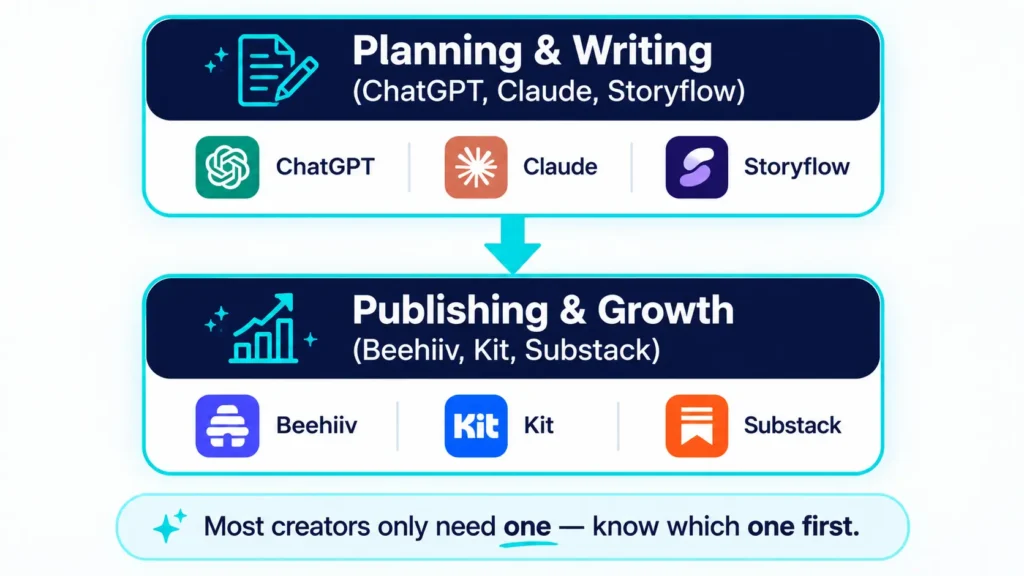
Layer one is planning and writing. Tools like ChatGPT, Claude, and dedicated apps like Storyflow help you research, outline, and draft the actual words. They don’t send a single email. No subscriber list, no analytics, no payments.
Layer two is publishing and growth. Platforms like Beehiiv, Kit, and Substack handle the sending, the list, the money, and — increasingly — basic AI features bolted on for subject lines and light rewriting. Most dedicated publishing platforms have simple AI for subject lines, but they lack real writing assistance built into the drafting process.
Confusing these two is exactly why so many creators buy an expensive publishing platform expecting it to solve their writing problem, then wonder why the blank page still feels the same. Know which gap you’re actually trying to close before you spend a cent.
AI Newsletter Writing Tools: Fixing the Blank Page
If your problem is staring at an empty draft every week, this is your layer.
ChatGPT remains the fastest, free starting point for AI newsletter writing tools. Paste your rough notes or bullet points, ask for a first draft in your established tone, and edit from there. It costs nothing and covers 80% of what most solo creators need.
For anyone treating newsletter planning as real, ongoing work — not just a Tuesday scramble — Storyflow takes a different approach worth knowing about. It’s a project canvas where your content calendar, audience notes, research, and drafts all live on one board, and the AI reads that full context rather than just the current prompt. The honest tradeoff: no email sending, no subscriber list, no payments. You pair it with a publishing platform, you don’t replace one with it.
→ See also: How to Use ChatGPT for Beginners: The Complete Guide
The practical setup most solo newsletter writers land on: draft in ChatGPT or Claude using a saved voice-and-tone prompt, then paste the finished piece into whatever platform actually sends it. Simple, free, and it solves the writing problem without paying for platform features you don’t need yet.
AI-Powered Publishing Platforms: Beehiiv vs Kit vs Substack
If writing isn’t your bottleneck and growth or monetization is, this is where the real decision lives.
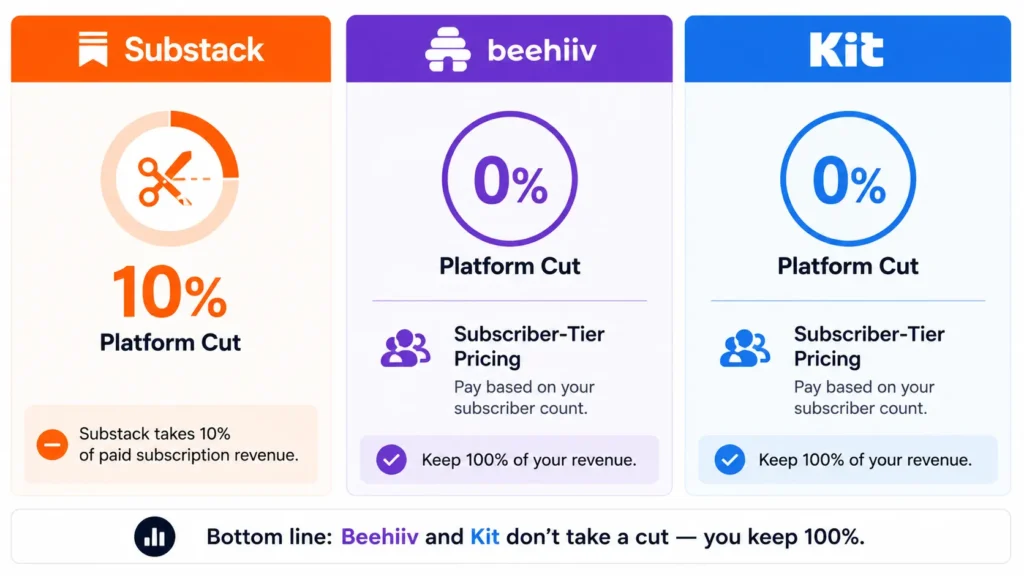
Substack remains the strongest choice for pure discovery. Its Notes feature and recommendation network mean new writers with zero existing audience can still get found. The tradeoff is real: Substack takes a 10% cut of subscription revenue, plus Stripe’s processing fee of roughly 2.9% plus 30 cents per transaction. A creator earning $10,000 monthly from subscriptions pays close to $1,000 in platform fees alone.
Beehiiv was built by former Morning Brew staff specifically for creators who think of their newsletter as a media business. It takes zero revenue share on paid subscriptions — pricing scales by subscriber count instead. The free Launch plan covers up to 2,500 subscribers with the referral program included, and its Boosts network lets even small newsletters earn $1 to $3 per subscriber referred through other publications. That specific monetization path doesn’t exist on Substack or Kit.
Kit (formerly ConvertKit) wins when your newsletter feeds a bigger business — courses, digital products, coaching, sponsorships. Its automation is genuinely the most advanced of the three: one creator reported a 22% increase in conversions after migrating their sequences to Kit. The free Newsletter plan covers up to 10,000 subscribers without needing any commerce features at all.
None of these three is universally “best.” The right one depends entirely on whether you’re optimising for discovery, for owned monetization, or for selling something beyond the newsletter itself.
AI Newsletter Subject Lines That Actually Get Opened
This is the single highest-leverage use of AI in the entire newsletter workflow, and it takes thirty seconds per issue.
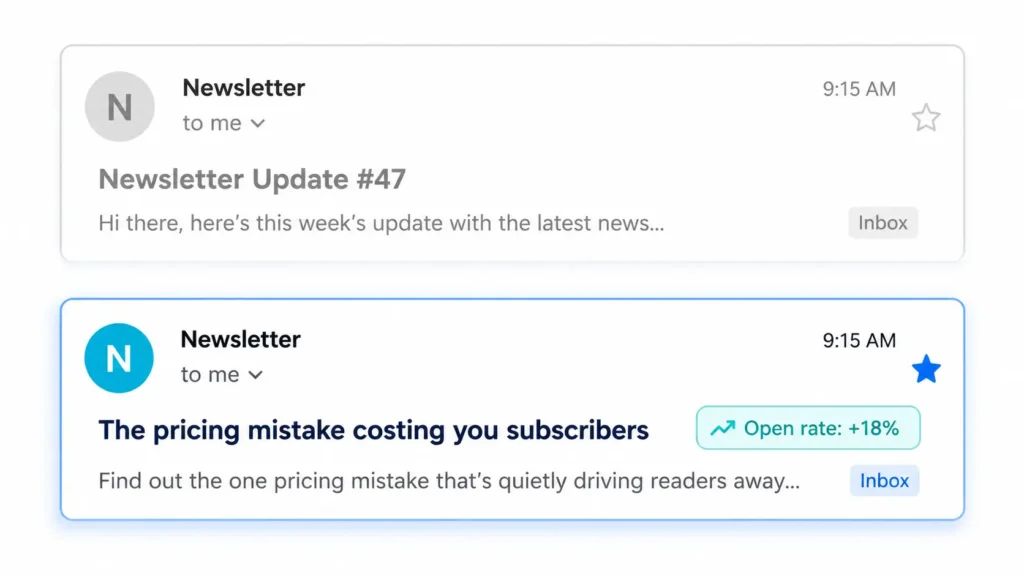
A generic subject line — “Newsletter Update #47” — gets ignored in a crowded inbox. Ask ChatGPT or your platform’s built-in AI tool to generate five alternate subject lines based on your issue’s actual content, specifically instructed to lead with the reader’s problem, not your topic. “The pricing mistake costing you subscribers” beats “This Week’s Newsletter” every single time it’s tested.
Most publishing platforms now ship basic subject-line AI as a built-in feature — this is genuinely one of the better applications of AI newsletter subject lines tooling because the task is narrow and the feedback (open rate) is immediate and measurable. Test two versions on a small segment if your platform supports it, and let the actual data pick the winner instead of guessing.
Newsletter Automation Tools: Segmentation Without the Headache
Once your list grows past a few hundred subscribers, sending the same email to everyone starts leaving real engagement on the table.
Newsletter automation tools solve this by tagging subscribers based on what they click, what they’ve bought, or how they signed up — then sending different follow-up sequences to each segment automatically. Kit’s visual automation builder is the most powerful of the major platforms here, closer to a full marketing automation tool than a simple newsletter sender.
Beehiiv’s 3D Analytics dashboard, available on its Growth plan, tracks engagement scoring per individual subscriber — showing exactly who opens every single issue, who’s gone quiet, and who’s ready for a one-click re-engagement segment. This solves the “vanity metrics” problem that shows you subscriber counts but nothing about who’s actually still reading.
The AI layer here isn’t writing anything. It’s deciding who should receive what, automatically, based on real behaviour — which frees up the time you’d otherwise spend manually building segments by hand.
Comparing the Platforms by What You’re Actually Trying to Build
Here’s the honest breakdown, matched to the outcome you’re actually chasing rather than a generic feature checklist.
| Platform | Best For | Revenue Share | Free Tier | Starting Paid Price |
|---|---|---|---|---|
| Substack | Discovery, zero existing audience | 10% + Stripe fees | Unlimited (with rev share) | N/A — free forever |
| Beehiiv | Newsletter-as-media-business | 0% | Up to 2,500 subscribers | $49/mo (Scale) |
| Kit | Courses, products, sponsorships | 0% | Up to 10,000 subscribers | $25/mo (Creator) |
| ChatGPT | Writing drafts, subject lines | N/A | Generous free plan | $20/mo (Plus) |
| Storyflow | Structured planning before publishing | N/A | No free tier | $9.99/mo (Plus, annual) |
The realistic starting stack for a brand-new newsletter: write in ChatGPT (free), publish on Substack or Beehiiv’s free tier (also free), and only start paying once your list or revenue actually justifies the upgrade. You do not need five subscriptions to start a newsletter in 2026. You need one writing habit and one place to send it.
What AI Won’t Fix About Your Newsletter
Let’s be straight about this, because the tools get oversold constantly.
AI cannot give people a reason to subscribe if your content doesn’t have one. A perfectly generated subject line on a genuinely boring issue still gets a low open rate. The tool amplifies what’s already working — it doesn’t invent value that isn’t there.
Automation without a real segmentation strategy is just noise, sent faster. Tagging subscribers means nothing if you never actually send them anything different based on those tags. Set the automation up with an actual plan, not just because the platform offers it.
A great platform doesn’t replace consistency. Substack’s discovery engine, Beehiiv’s Boosts network, and Kit’s automation all compound over time — but only if you’re actually publishing regularly enough for any of it to compound. The tool is not the newsletter. You are.
Frequently Asked Questions About AI Newsletter Tools
Q: What are the best free AI newsletter tools?
A: For writing, ChatGPT’s free plan handles drafts, outlines, and subject line generation with no cost. For publishing, Substack is free indefinitely (with a 10% revenue share on paid subscriptions), and Beehiiv’s free Launch plan covers up to 2,500 subscribers including its referral program. Together, these free AI newsletter tools cover writing and publishing without any upfront spend.
Q: Should I choose Beehiiv or Kit for my newsletter?
A: It depends on what you’re building. Beehiiv vs ConvertKit (Kit) comes down to this: choose Beehiiv if your newsletter is the business itself and you want zero revenue share plus strong growth tools like the Boosts referral network. Choose Kit if your newsletter feeds a bigger operation — courses, digital products, sponsorships — since its automation and commerce integration are the most advanced of the two.
Q: Can ChatGPT actually write a full newsletter for me?
A: ChatGPT for newsletters works best as a drafting partner, not a fully autonomous writer. Give it your rough notes, bullet points, or key stories, along with a saved instruction describing your tone and audience, and it produces a strong first draft in seconds. You’ll still want to edit for accuracy, add your own voice, and verify any facts or statistics before sending — treat the output as a draft, not a final version.
Q: Do AI newsletter subject lines actually improve open rates?
A: Yes, when done well. AI newsletter subject lines that focus on the reader’s specific problem rather than a generic label consistently outperform vague alternatives like “This Week’s Newsletter.” Most major publishing platforms, including Beehiiv and Kit, now offer built-in AI subject line generation — testing two versions on a small segment before sending to your full list is the most reliable way to confirm which one wins for your specific audience.
Q: What’s the difference between newsletter writing tools and newsletter platforms?
A: Writing tools like ChatGPT, Claude, and Storyflow help you research, outline, and draft your content — they don’t send emails, manage subscribers, or process payments. Publishing platforms like Beehiiv, Kit, and Substack handle sending, list management, monetisation, and growth features, with basic AI increasingly built in for subject lines. Most creators need both working together, not one replacing the other.
Q: Is Substack still worth using in 2026 with the 10% revenue share?
A: For writers starting with zero audience, yes — Substack’s discovery network and Notes feature remain the strongest built-in way to get found by new readers without existing marketing. Once your subscription revenue grows substantial enough that the 10% cut plus Stripe fees represents real money, migrating to a zero-revenue-share platform like Beehiiv or Kit becomes financially worth the tradeoff in discovery features.
Pick the Layer You’re Actually Missing
You don’t need to solve writing and growth at the same time this week.
If the blank page is your problem, open ChatGPT right now and draft your next issue from a few rough notes. If growth or monetisation is the real gap, compare Beehiiv’s free tier against Kit’s free tier this afternoon and pick based on where your newsletter is actually headed.
AI newsletter tools only work when they’re solving the specific problem you actually have — not the one a sales page assumes you have. Pick your layer. Start there.
Want more practical AI guides for creators and small business owners? Browse our full library at GetFuturix.com.
Related articles on GetFuturix: