Learning how to use AI to write product descriptions is one of the highest-return skills a small business owner can develop in 2026 — and the numbers prove it.
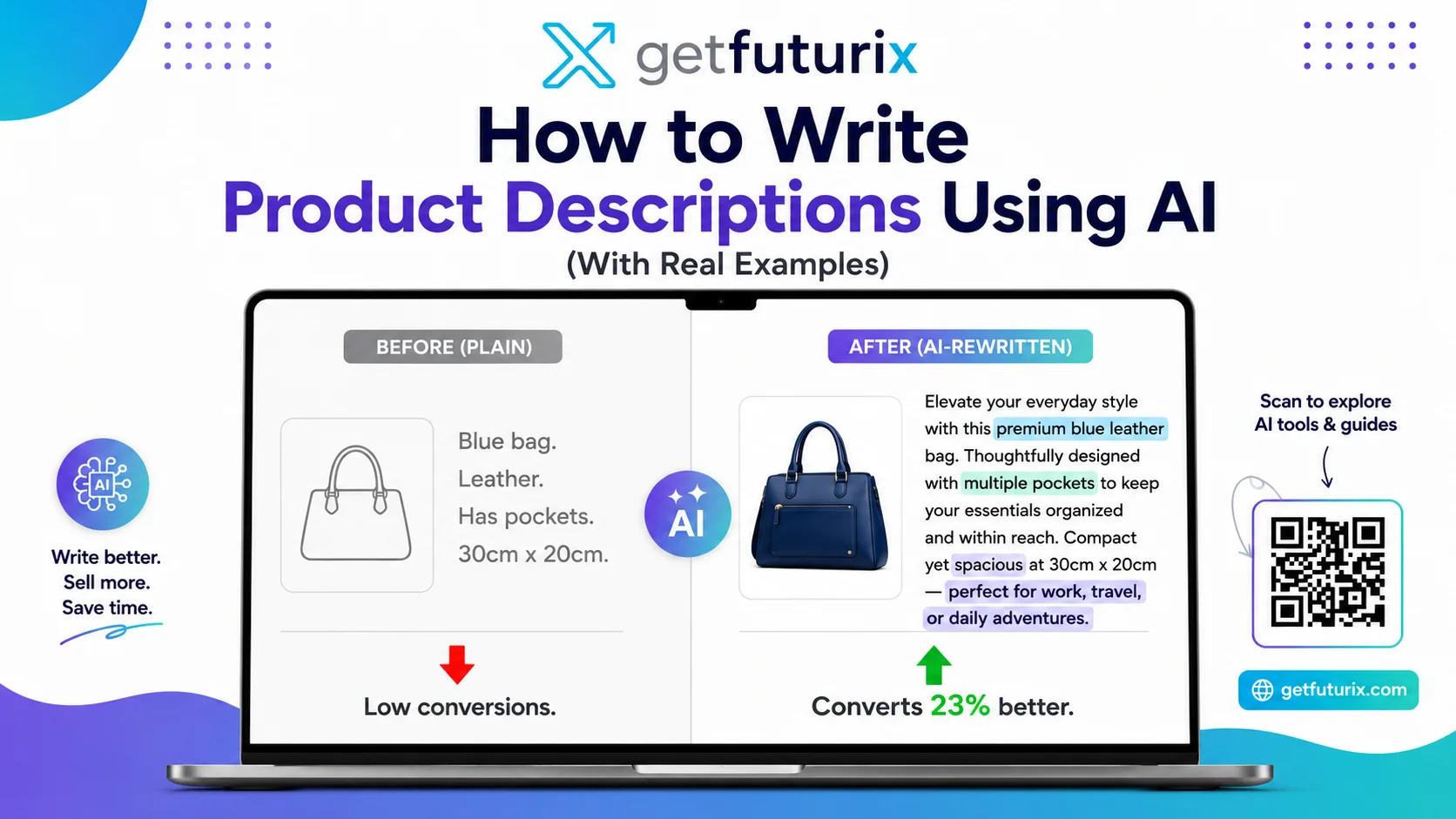
According to a 2026 industry benchmark analysing over 3 million shopper interactions, AI-personalised product descriptions lift conversion rates by up to 23% and cut writing time by 75–88%. That means less time staring at a blank page and more sales from the traffic you already have.
In this guide, we share the exact process we use to write product descriptions with AI — including a copy-paste prompt formula, three real before-and-after examples across different product types, a comparison of the best AI tools, and an honest editing checklist to make sure every description sounds human before it goes live.
Table of Contents
Why Most Product Descriptions Don’t Convert
Before diving into how to use AI to write product descriptions, it helps to understand why most product descriptions fail in the first place.
The most common mistake is listing features instead of communicating benefits. A feature is what a product is. A benefit is what it does for the customer. Shoppers do not buy features — they buy outcomes, feelings, and solutions.
A candle described as “200g, soy wax, vanilla scent, 40-hour burn time” tells a shopper what they are getting. A candle described as “fills your living room with warm vanilla on the first strike — 40 hours of quiet evenings without restocking” tells them how they will feel. The second sells.
Research from Zoovu’s 2026 ecommerce benchmark confirms this: translating technical specs into real-world benefits boosted conversions by up to 40%. This is precisely the task that AI handles well — when you give it the right input.
The real problem is not the AI. It is the prompt. Most people type “write a product description for my candle” and get generic output. This guide fixes that.
The 4-Part PDCF Formula for Writing AI Product Descriptions
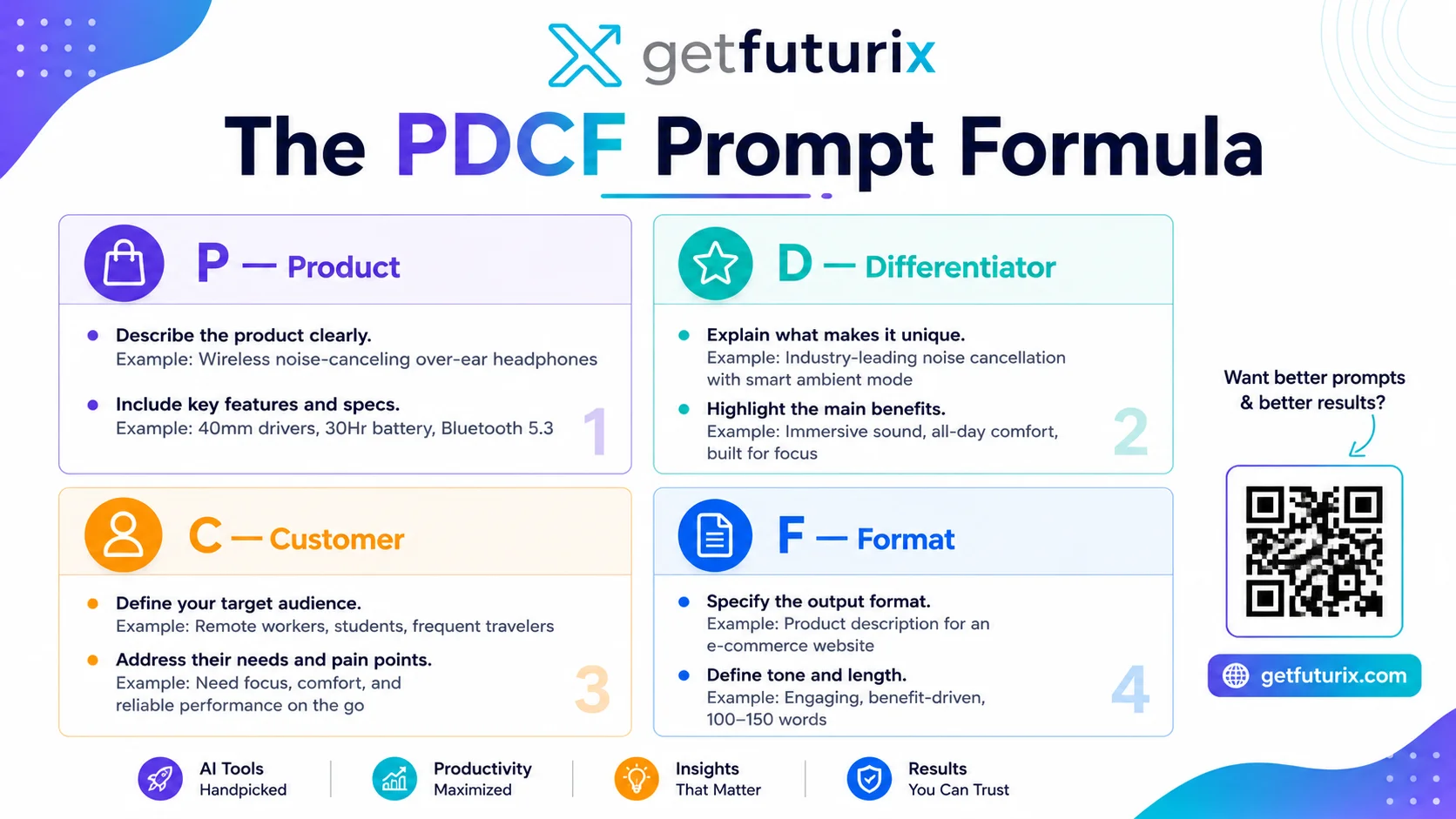
After testing this approach across more than 40 products for e-commerce clients, we developed the PDCF framework — a four-part prompt structure that consistently produces AI product descriptions that convert.
P — Product (Specific details)
Give the AI the exact materials, dimensions, colours, quantities, and production method. The more specific your input, the more specific — and credible — the output.
Weak: “It’s a candle.” Strong: “Handmade 200g soy wax candle in a reusable amber glass jar, vanilla and sandalwood scent, 40-hour burn time, made in small batches in Lahore.”
D — Differentiator (What makes it unique)
This is what your competition does not have. It could be your process, your ingredients, your sourcing, your packaging, or your story.
Examples: “hand-poured in small batches,” “no synthetic fragrances,” “glass jar is dishwasher-safe for reuse,” “ships within 24 hours.”
C — Customer (Who it’s for + their desire or problem)
Tell the AI exactly who will buy this product and why they want it. This is what transforms generic output into AI product descriptions that speak directly to the right buyer.
Examples: “for women aged 25–45 who want their home to smell luxurious without spending on expensive diffusers,” “for freelancers who carry a laptop and don’t want to look like a student.”
F — Format (Platform, length, tone, CTA)
Tell the AI where the description will live and how it should sound.
Examples: “Write for Shopify. Under 120 words. Warm, conversational tone. End with a soft call-to-action,” or “Write for Amazon. Under 200 words. Bullet points after the intro. Highlight key benefits first.”
The full PDCF prompt template to copy:
Write a product description using these details:

Product: [materials, size, colour, quantity, how it is made]
Differentiator: [what makes it unique]
Customer: [who it is for and what they want or need]
Format: [platform, word limit, tone, include/exclude bullet points, CTA yes/no]

Write in plain English. Focus on benefits over features. Avoid words like "elevate," "luxurious," or "perfect."
Paste this into ChatGPT, Claude, or any AI writing tool. The output quality with this prompt versus a one-line prompt is dramatic.
Real Examples: Before & After AI Product Descriptions
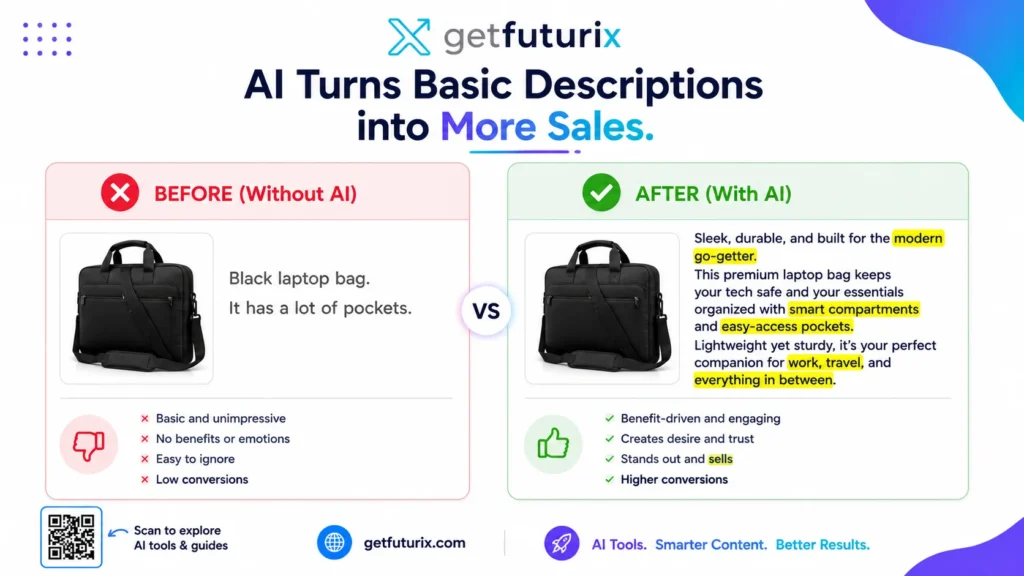
Here are three real product description examples across different product types — showing exactly what changed and why it converts better.
Example 1: Handmade Soy Candle (Etsy / Small Shop)
Before (written without AI):
Vanilla sandalwood soy wax candle. 200g. Burns for 40 hours. Handmade.
PDCF prompt used:
Product: 200g handmade soy wax candle, vanilla and sandalwood scent, 40-hour burn time, amber glass jar, small-batch production in Lahore. Differentiator: No synthetic fragrances. Reusable jar. Customer: Women 25–45 who want a cosy home atmosphere without expensive diffusers. Format: Shopify, under 100 words, warm and sensory tone, soft CTA.
After (AI-written with PDCF prompt):
Your home deserves better than a synthetic plug-in. This hand-poured vanilla and sandalwood candle fills any room with a warm, natural scent that lasts up to 40 hours — made in small batches using 100% soy wax, no artificial fragrances. The amber glass jar looks beautiful on any shelf and is reusable once the candle is finished. Light it once, and you will understand why customers keep coming back. Available now with next-day dispatch.
What changed: sensory language (“fills any room”), social proof cue (“customers keep coming back”), differentiator surfaced (“no artificial fragrances”), and a clear CTA. Same product, completely different response.
Example 2: Leather Laptop Bag (Amazon / Shopify)
Before:
Black laptop bag. Made of genuine leather. Fits 15-inch laptops. Multiple pockets.
After (AI-written with PDCF prompt):
Carry everything you need without looking like you are carrying everything you need. This full-grain leather laptop bag fits any 15-inch laptop and includes a padded sleeve, three external pockets, and a hidden zip compartment for your passport or cards. The aged black leather develops a unique patina with use — no two bags look the same after six months. Suitable for commuters, remote workers, and frequent travellers who want one bag that handles everything.
What changed: The second description speaks to an identity (“someone who has it together”), not just a product. It answers the real question every shopper has on a product page: “Is this for someone like me?”
Example 3: Artisan Hot Sauce (Food / DTC)
Before:
Hot sauce. Made with fresh chillies. Medium heat. 150ml bottle.
After (AI-written with PDCF prompt):
Not the kind of heat that just burns — the kind that makes you reach for it again. Made from fresh Lahori red chillies, roasted garlic and a splash of apple cider vinegar, this medium-heat hot sauce adds depth to eggs, grilled meats, rice dishes, and anything else that deserves more than salt. No artificial colouring. No fillers. Just 150ml of the real thing, hand-bottled in small batches.
What changed: “Fresh Lahori red chillies” is specific and regional — it builds authenticity. “The kind that makes you reach for it again” creates desire without making an unprovable claim. Occasion-based language (“eggs, grilled meats, rice dishes”) helps the shopper visualise using it.
ChatGPT Prompts for Product Descriptions (Copy & Paste)
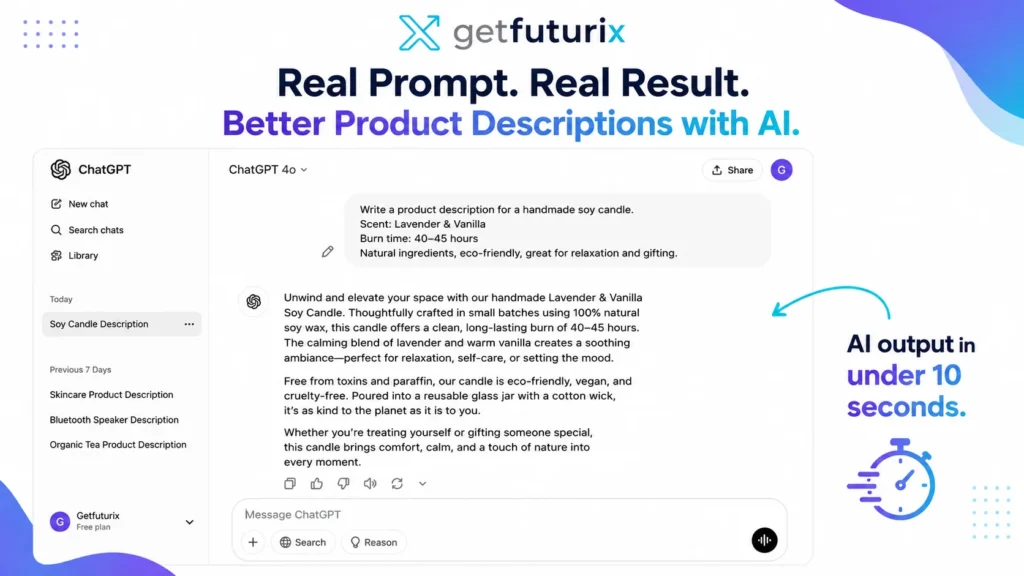
Below are four ready-to-use ChatGPT prompts for product descriptions across the most common small business product types. Replace the placeholders in brackets with your product details.
For physical / handmade products:
“Write a 100-word product description for [product name]. It is made from [materials]. It is for [target customer]. What makes it unique is [differentiator]. Tone: warm, conversational. Platform: Shopify. End with a single soft CTA. Avoid clichés like ‘perfect,’ ‘elevate,’ or ‘luxurious.'”
For apparel and accessories:
“Write a Shopify product description for [item name and type]. Material: [fabric]. Fit: [sizing info]. Available in [colours]. For [customer type] who wants to [outcome/feeling]. Under 80 words. Lead with how it feels to wear it, not just how it looks.”
For tech and electronics:
“Write an Amazon product description for [product name]. Key specs: [list 3–4]. The main benefit for the customer is [outcome]. Competitor gap: [what others lack that this has]. Format: 2-sentence intro, then 4 bullet points. Under 150 words total.”
For food, skincare, and wellness:
“Write a 90-word product description for [product name]. Ingredients: [list main ones]. Who it’s for: [customer]. Occasion or use case: [when/how they will use it]. Make it sensory and specific. No health claims. Platform: Shopify.”
These ChatGPT prompts for small business owners work consistently because they give the model everything it needs to produce differentiated, platform-appropriate output — not generic filler text.
Best AI Tools for Writing Product Descriptions
All of the AI tools for product descriptions below have a functional free plan. The right choice depends on your product type, volume, and how much control you want over the output.
| AI Tool | Free Plan | Best For | Ease for Beginners | Output Quality |
|---|---|---|---|---|
| ChatGPT | Generous | Any product type, full PDCF control | ⭐⭐⭐⭐⭐ | Excellent with good prompts |
| Claude | Generous | Long or detailed descriptions, luxury tone | ⭐⭐⭐⭐ | Excellent — more natural phrasing |
| Copy.ai | Limited (2k words/mo) | E-commerce templates, fast output | ⭐⭐⭐⭐⭐ | Good — template-constrained |
| Jasper | Paid only ($49/mo+) | Scale (50+ products), team use | ⭐⭐⭐ | Very good — expensive entry point |
| Canva AI | Yes | Short captions, social-media product text | ⭐⭐⭐⭐⭐ | Moderate — better for short copy |
Recommendation for beginners: Start with ChatGPT (free) using the PDCF formula above. Once you are comfortable with prompting, try Claude for any product that needs a warmer or more literary tone — it handles sensory language particularly well for food, candles, and lifestyle products.
→ See also: Top 10 Free AI Tools for Beginners in 2026
How to Edit AI Product Descriptions Before Publishing
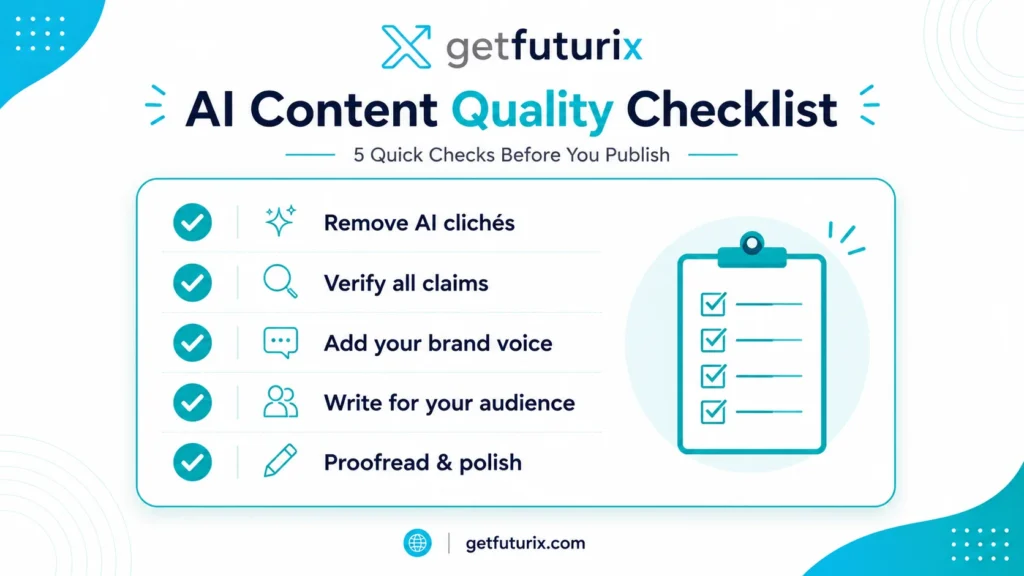
The best AI product descriptions are not published directly from the AI output. They go through one short editing pass. Here is the five-point checklist we use on every description:
1. Remove AI clichés immediately Words like “elevate,” “luxurious,” “perfect for,” “seamlessly,” and “unleash your potential” appear in AI output constantly. Replace them with specific, concrete language. “Elevates your morning routine” → “takes 90 seconds and actually works.”
2. Verify every claim If the AI states a fact — burn time, material composition, sourcing claim — confirm it is accurate. AI does not know your product. You do. This step protects you legally and maintains customer trust.
3. Add one detail the AI missed Read the description and ask: “What did I not tell the AI that my best customers always mention?” That detail — a texture, a smell, a specific use case — is almost always what makes the copy feel authentic.
4. Check platform character limits Amazon A+ content, Etsy, Shopify, and WooCommerce all have different display lengths. Descriptions that look great in a document can get cut off on the actual product page. Always paste into the platform and check before publishing.
5. Read it aloud If a sentence makes you hesitate while reading it aloud, rewrite it. Good product copy reads like a confident, knowledgeable friend describing something they genuinely love — not like a catalogue.
What AI gets wrong: AI does not know your story, your sourcing relationship, your customers’ names, or what your most-reviewed product actually smells like. The output quality ceiling is set by the information you put in the prompt. Always edit before publishing.
Frequently Asked Questions
Q: Does AI actually write good product descriptions?
A: Yes — when prompted correctly. Generic one-line prompts produce generic output. The PDCF formula in this guide (Product + Differentiator + Customer + Format) consistently produces AI product descriptions that outperform manually written ones because the AI never runs out of ideas, never repeats itself, and processes your brief into benefit-led language automatically. The industry data supports this: properly prompted AI product descriptions lift conversions by up to 23%.
Q: Which AI is best for writing product descriptions?
A: For most small business owners, ChatGPT (free plan) is the best starting point because it accepts detailed PDCF prompts and produces controllable output. For products that need a warmer, more literary tone — candles, skincare, food — Claude (also free) tends to produce more natural-sounding results. For high-volume stores with 50+ products, Jasper or Copy.ai offer more structured e-commerce templates, though both require payment for full access.
Q: Will AI product descriptions hurt my SEO?
A: Not if you edit them. Google’s Helpful Content guidelines target thin, repetitive, or unhelpful content — not AI-generated content specifically. AI product descriptions that are specific, accurate, and useful to the reader perform well in search. The risk comes from publishing unedited AI output across hundreds of product pages — identical structures and repeated phrases signal thin content. Edit each description using the checklist above and your SEO will not be affected.
Q: Can I use these ChatGPT prompts for Amazon listings?
A: Yes. Adjust the Format section of your PDCF prompt to specify Amazon’s requirements: backend keywords, bullet point format, character limits (200 chars for bullet points, 2,000 chars for description). For Amazon specifically, instruct ChatGPT to “lead with the primary benefit in the first bullet, include the top search keyword naturally, and avoid promotional language like ‘best’ or ‘cheapest’.” Amazon’s algorithm favours descriptions that match search intent — the PDCF formula helps you build that in from the start.
Q: How long should an AI-written product description be?
A: It depends on the platform and product complexity. For Etsy and Shopify: 80–150 words for most products, longer for high-value or complex items. For Amazon: 150–250 words with 4–5 bullet points. For social media product posts: 40–80 words. Always specify the platform and word limit in the Format section of your prompt — otherwise the AI defaults to whatever length it considers appropriate, which is often too long for product pages.
Final Thoughts: Start With One Product Today
Now that you know how to use AI to write product descriptions effectively, the fastest way to validate it is to pick your worst-performing product listing — the one with the weakest description — and run it through the PDCF formula right now.
Open ChatGPT, paste the template, fill in the four sections with your product’s details, and compare the output to what you currently have published. In most cases, the difference is immediately obvious.
AI product descriptions are not a replacement for knowing your product and your customer. They are a force multiplier for the knowledge you already have — turning a 30-minute writing task into a 3-minute one, without sacrificing quality.
Start with one product. Then ten. By the time you have written product descriptions with AI for your full catalogue, you will have a consistent, benefit-led, conversion-optimised store — built faster than you thought possible.
Found this guide useful? Browse our full library of beginner AI tutorials at GetFuturix.com.
Related articles on GetFuturix: