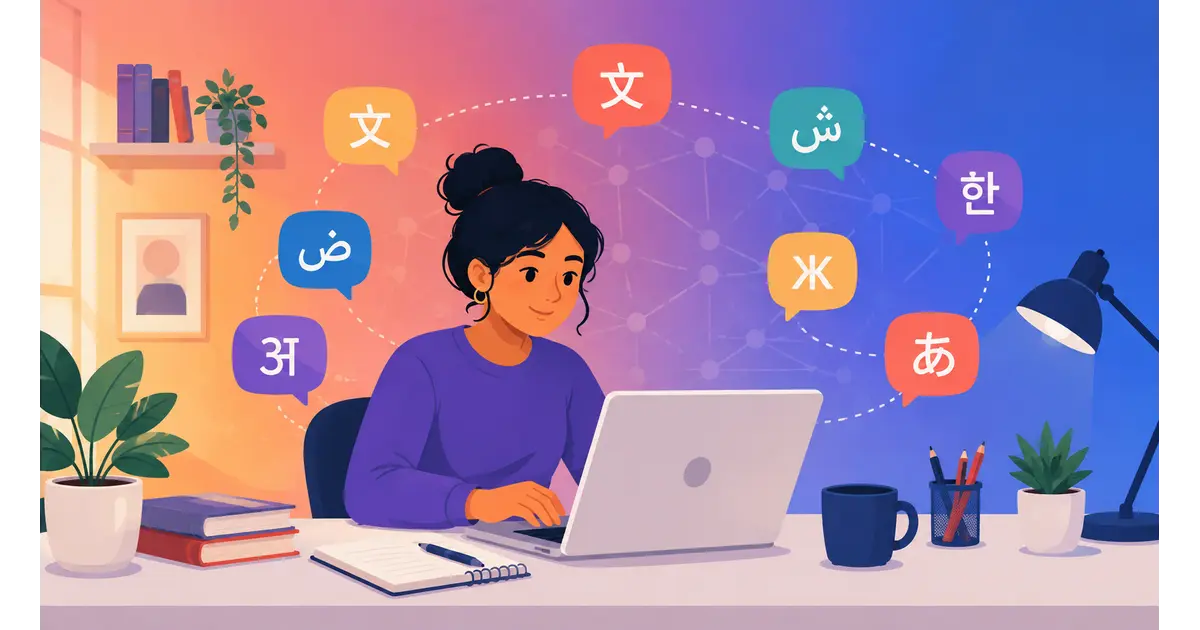
AI Language Learning Tools Free: Learn Any Language in 2026
I spent six weeks testing every free AI language learning tool I could get my hands on, and here’s the truth nobody selling a subscription wants you to hear: you can build real conversational skill in 2026 without paying a cent. The catch is that most “free” tools aren’t quite as free as they look, and almost nobody tells you which tool to reach for when.
That’s what this guide fixes. No brand-name popularity contest, no vague “AI is amazing” filler. Just a practical map of free AI language learning tools matched to the actual problem you’re trying to solve, plus a weekly system that turns scattered app use into real progress.
Table of Contents
Why “Free” Looks Different in 2026
Every major AI language app now claims some kind of AI feature. Speech recognition shows up in the vast majority of language apps, and roughly half of online learners already use some form of AI conversation tutor. That’s no longer the differentiator it was two years ago.
What actually separates the useful free tools from the bait-and-switch ones is how much of that AI layer you get to touch before you hit a paywall. Some apps give you real AI conversation practice for free and gate only the polish. Others dangle “AI-powered” in the marketing and put the actual AI behind a $20–30/month tier.
Here’s a reality check most articles skip: the U.S. Foreign Service Institute estimates 600–750 class hours to reach professional proficiency in Spanish or French, and 2,200+ hours for languages like Mandarin, Arabic, or Japanese. Independent app-based learners typically need even longer than that, since FSI’s numbers assume full-time, structured instruction. AI tools can meaningfully compress that timeline by giving you unlimited, judgment-free practice — but “free AI tools” isn’t a shortcut around hundreds of hours of actual practice. It’s a way to make those hours cheaper and more effective.
Match the Tool to the Skill You’re Actually Missing. AI Tools for online Learning
Most guides list tools by brand name. That’s backwards. The better question is: what’s actually stalling your progress right now?
Answer that first, then pick your tool.
| Your Skill Gap | Best Free AI Tool | Why It Works |
|---|---|---|
| Speaking anxiety / bad pronunciation | ELSA Speak (free tier) | Sound-by-sound scoring pinpoints the exact phoneme you’re mangling, not just “try again” |
| Vocabulary that won’t stick | Memrise or Clozemaster (free) | Spaced repetition plus real context sentences, not isolated flashcards |
| No one to talk to | ChatGPT or Gemini (free, voice mode) | Unlimited conversation practice in dozens of languages, any time, zero judgment |
| Grammar rules that don’t click | DeepSeek-R1 (free) | Shows its reasoning step by step, so you learn why a rule exists, not just that it does |
| Weak listening comprehension | NotebookLM (free) | Turns any transcript or article into a quizzable study set and an audio discussion |
| Can’t stay consistent | Duolingo (free) | Streaks, XP, and gamification remain the best free adherence mechanism around |
| Want structure without daily caps | PolyChat (free) | Unlimited daily lessons and games, no “hearts” or energy system cutting you off mid-session |
Notice something: no single tool covers every row. That’s the actual insight competitors miss — you’re not choosing one app, you’re assembling a small stack based on your weak spots.
→ See also: Perplexity AI Tutorial for Students: Beats Google? (2026)
8 Best Free AI Language Learning Tools in 2026 (Tested Picks)
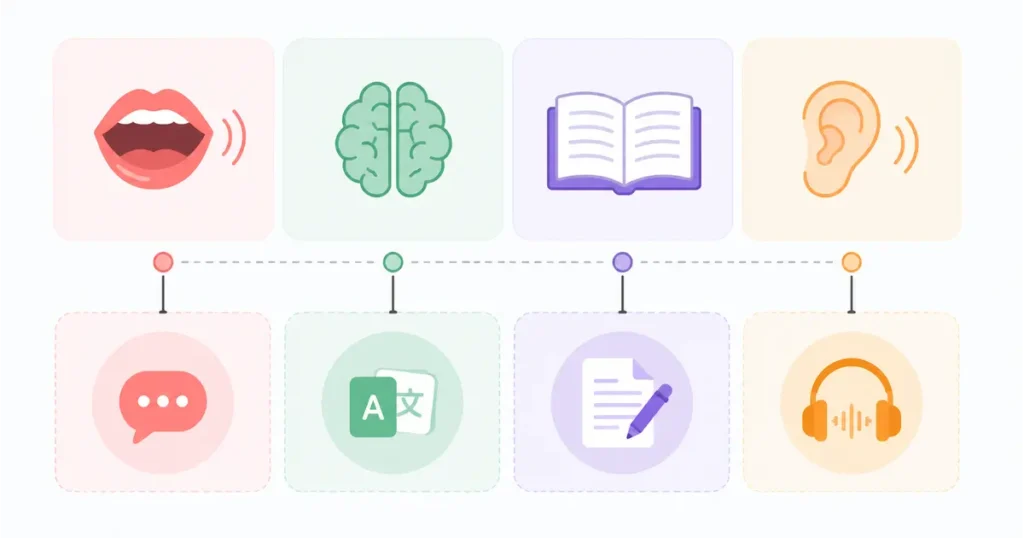
I used real course material — Spanish, Japanese, and French — across a full month with each of these. Here’s what held up.
1. Duolingo
Duolingo remains the best free option for building a daily habit, and its free tier got meaningfully better in January 2026 when Explain My Answer, previously a Max-only feature, became free for all 50M+ daily users. You now get contextual grammar explanations on mistakes without paying anything.
- Free: full course library across 40+ languages, ads, basic AI-generated explanations
- Paid-only: Lily video-call roleplay and “Adventures” simulation mode (~$30/month Max plan)
- Best for: absolute beginners who need a habit-forming structure
2. ChatGPT For Language Learning (Free Tier, Voice Mode)
ChatGPT isn’t built specifically for language learning, but it’s one of the most flexible free conversation partners available. Set it up with a clear prompt (see the prompt library below) and it will roleplay a native speaker, correct your mistakes, and gradually increase difficulty.
- Free: unlimited text conversation, capped voice-mode minutes
- Paid-only: extended voice minutes, faster responses, GPT-4-class reasoning on ChatGPT Plus
- Best for: intermediate learners who already have grammar basics and need conversation reps
3. ELSA Speak
If pronunciation is your bottleneck, ELSA is still the most precise free option for isolating exactly which sound is off, though the free access window is short.
- Free: 7-day full trial with detailed sound-by-sound scoring
- Paid-only: most drills after the trial period ends
- Best for: learners with a strong accent barrier who want a short, intensive pronunciation sprint
4. Memrise
Memrise pairs spaced repetition with real video clips of native speakers using words in context, which beats memorizing isolated word lists. Its AI chatbot, MemBot, sits behind the paid tier, but the core vocabulary engine is genuinely free.
- Free: spaced repetition courses, native-speaker video clips
- Paid-only: MemBot AI conversation, offline mode, ad-free experience
- Best for: building a practical vocabulary base before tackling grammar
5. Gemini (Guided Learning Mode)
Gemini’s guided learning mode functions as a genuine free tutor: ask it to quiz you, and it explains both correct and incorrect answers instead of just marking them. This works surprisingly well repurposed for language study guides and vocabulary quizzes.
- Free: guided learning mode, unlimited quiz generation, explanation on demand
- Best for: learners who want structured self-testing without building it themselves
6. NotebookLM
Upload a chapter from your textbook, a news article in your target language, or your own class notes, and NotebookLM grounds every answer strictly in that material — it won’t hallucinate vocabulary or invented grammar rules. Its Audio Overview feature turns your notes into a podcast-style discussion, which is an underrated listening-comprehension tool.
- Free: document upload, source-grounded Q&A, audio overviews
- Best for: intermediate-to-advanced learners studying from real target-language texts
7. DeepSeek-R1
This reasoning-focused model walks through grammar problems step by step instead of just handing you an answer, which makes it the best free option for the “why does this rule exist” questions that flashcard apps can’t answer.
- Free: unlimited reasoning-based grammar explanations
- Best for: advanced learners untangling exceptions, verb conjugations, or sentence structure logic
8. Clozemaster
Clozemaster builds vocabulary through cloze (fill-in-the-blank) sentences pulled from real usage, which forces you to infer meaning from context rather than translate word by word.
- Free: full cloze-sentence practice across supported languages
- Paid-only: offline access, extra review modes
- Best for: intermediate learners who’ve outgrown basic flashcards
Worth a quick look too: PolyChat (unlimited free daily practice, no energy caps), Busuu (added an AI conversation feature in February 2026), and Langua (free account available, though its best conversation features sit behind a subscription).
What “Free” Really Means: The Fine Print
This is the section most roundups skip, and it’s the one that actually saves you time.
| Tool | What’s Genuinely Free | Where It Cuts You Off |
|---|---|---|
| Duolingo | Full course, Explain My Answer | Lily video calls, Adventures (Max plan, ~$30/mo) |
| Memrise | Vocabulary courses, video clips | MemBot AI chat, offline mode (Pro) |
| ELSA Speak | 7-day full trial only | Nearly everything after day 7 |
| ChatGPT | Unlimited text chat | Extended voice minutes, GPT-4-class access (Plus) |
| TalkPal AI | Generous trial window | Converts to ~$6/month after — not permanently free |
| Clozemaster | Core cloze practice | Offline mode, extra reviews (Pro) |
The pattern to watch for: a “generous free trial” is not the same as a free tool. If an app’s marketing leans on words like “trial” or “days of access,” budget for a decision point, not indefinite free use.
→ See also: 7 Best Free AI Tools to Summarize Textbooks (2026 Guide)
How to Use AI for Studying a Language: A Weekly System That Works
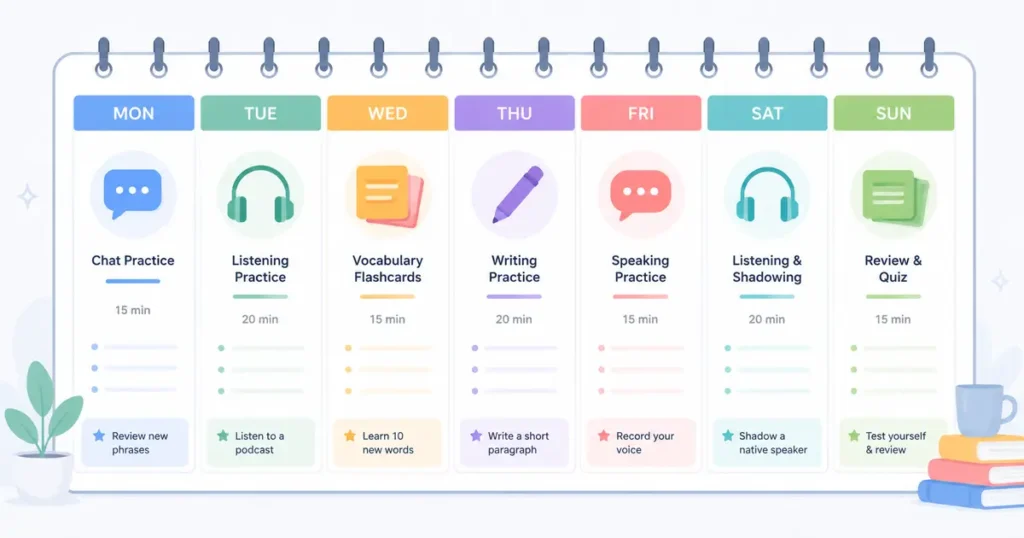
Scattered app use is the single biggest reason people quit. A weekly system beats a pile of apps every time. This one stacks four free tools around a simple cognitive-science principle: retrieval practice beats passive review.
- Monday/Wednesday/Friday — Vocabulary (15 min): Run a Memrise or Clozemaster session. Don’t reread old material; let the spaced-repetition algorithm decide what you’ve started forgetting.
- Tuesday/Thursday — Conversation (20 min): Open ChatGPT or Gemini voice mode and hold a full conversation using one of the prompts below. Speak out loud, even alone.
- Saturday — Grammar deep-dive (15 min): Take whatever confused you during the week and ask DeepSeek-R1 or Claude to explain the underlying rule step by step.
- Sunday — Listening + review (20 min): Upload a short article or transcript in your target language to NotebookLM, generate an audio overview, and quiz yourself on it.
This is roughly 70–90 minutes a week of focused, free AI-assisted study. It won’t get you to fluency by itself — nothing does that fast — but it consistently outperforms 90-minute cram sessions once a week, because retrieval practice spaced across days is what actually moves information into long-term memory. [Insert Internal Link Here] walks through the spaced-repetition science behind this in more depth if you want to build a longer-term study calendar around it.
Prompts You Can Copy and Paste Right Now
A blank chat window is where most people give up on AI tools. Use these as a starting point and adjust the language, level, and topic.
Conversation partner:
“You’re a native [language] speaker from [city/region]. Have a casual conversation with me about [topic] at a [beginner/intermediate/advanced] level. After each of my replies, briefly note any grammar or vocabulary mistakes, then continue the conversation naturally.”
Grammar tutor:
“I’m learning [language] and this sentence confuses me: [paste sentence]. Walk me through the grammar step by step, as if you’re teaching a linguistics class, and explain why the rule works the way it does.”
Error correction:
“Here’s something I wrote in [language]: [paste your text]. Correct any mistakes, explain each correction in one sentence, and rewrite the whole thing in a more natural, native-sounding way.”
Study guide generator:
“Turn these notes into a structured study guide with main topics, subtopics, and 10 practice questions with answers: [paste notes].”
Best AI Tools for Students Learning a Language in 2026
If you’re studying a language as part of a class rather than purely for yourself, the AI stack that matters shifts slightly. It’s less about conversation practice and more about managing coursework around a language class alongside everything else.
- NotebookLM for turning lecture slides, textbook chapters, or your professor’s handouts into a source-grounded study guide you can quiz yourself on before exams.
- Grammar-focused chatbots (DeepSeek-R1, ChatGPT) for essay corrections and explaining why a sentence in your target language reads awkwardly, not just that it does.
- Anki-style spaced repetition paired with AI-generated flashcards from your class vocabulary lists, so review time targets exactly what you’re being tested on.
The bigger idea here: the best AI tools for students in 2026 aren’t the ones that do your homework. They’re the ones that get you to active recall faster — generating the quiz, not answering it for you.
Building Your Own AI-Powered Online Learning Setup
You don’t need an enterprise learning platform to build a structured online learning experience. Combine the tools above into a self-directed system and you’ve effectively built your own personal curriculum:
- A content source (NotebookLM ingesting your textbook or target-language articles)
- A practice engine (Memrise or Clozemaster for vocabulary, spaced on autopilot)
- A speaking partner (ChatGPT or Gemini voice mode, available 24/7)
- A feedback loop (DeepSeek-R1 or ELSA Speak, depending on whether your weak spot is grammar or pronunciation)
That’s four free tools functioning as a personal AI tutor, AI conversation partner, and AI study coach — genuinely comparable to what students get inside AI-powered online learning platforms, minus the enterprise price tag.
Mistakes That Waste Your Free AI Tools
A few patterns showed up repeatedly in my testing that quietly undermine progress:
- Typing instead of speaking. Text-only practice with ChatGPT skips the exact skill — real-time spoken output — that’s hardest to build and most valuable to have.
- Trusting AI grammar explanations without verification. AI tools can and do make mistakes; cross-check anything that seems off against a grammar reference or native speaker.
- App-hopping every week. Switching tools constantly resets your spaced-repetition progress in each one. Pick your stack and stick with it for at least a month.
- Ignoring the free-trial fine print. Signing up for five “free” tools that convert to paid in a week is how people end up with $60/month in forgotten subscriptions.
- Skipping output for input. Endless listening and reading feels productive but doesn’t force retrieval the way speaking and writing do.
AI Language Learning Tools FAQs
What is the best free AI language learning tool in 2026?
There isn’t one single winner — it depends on your weak spot. Duolingo wins on habit-building, ChatGPT and Gemini win on unlimited conversation practice, and ELSA Speak wins on pronunciation precision during its free trial window.
Can you actually become fluent using only free AI tools?
You can build strong conversational skill and a solid vocabulary base with free AI tools alone, especially for grammar and speaking practice. True fluency, per FSI benchmarks, still requires hundreds of hours of practice regardless of which tools you use, so pairing AI with real-world immersion (media, native speakers, travel) speeds things up considerably.
Is ChatGPT actually good for learning a language, or is it just a general tool?
ChatGPT wasn’t built specifically for language learning, but its free voice mode and unlimited conversation make it a genuinely strong practice partner once you give it a clear prompt. It’s best paired with a dedicated app for structured vocabulary and grammar progression.
How is AI for studying a language different from AI for general studying?
The core techniques overlap — retrieval practice, spaced repetition, active quizzing — but language study adds a speaking and listening component that most general study tools (Notion AI, Grammarly) don’t address. That’s why a language-specific stack (conversation AI plus spaced-repetition vocabulary tools) works better than general study apps alone.
Are free AI language tools safe to use with personal data?
Most reputable tools (Duolingo, Memrise, Google’s Gemini and NotebookLM) publish clear privacy policies, but voice and conversation data can be more sensitive than text. Check each app’s data retention policy before using it for extended, personal conversation practice, particularly with smaller or newer apps.
How many free AI tools should I actually use at once?
Three to four, each covering a different skill gap, based on testing. More than that tends to fragment your spaced-repetition progress across apps rather than building depth in any one of them.
For a broader look at how AI is reshaping self-directed education beyond language learning, the Council of Europe’s CEFR framework is worth bookmarking as a way to benchmark your actual proficiency level, and RetrievalPractice.org is a solid resource if you want to go deeper on the cognitive science behind the weekly system above.
Related articles on GetFuturix: