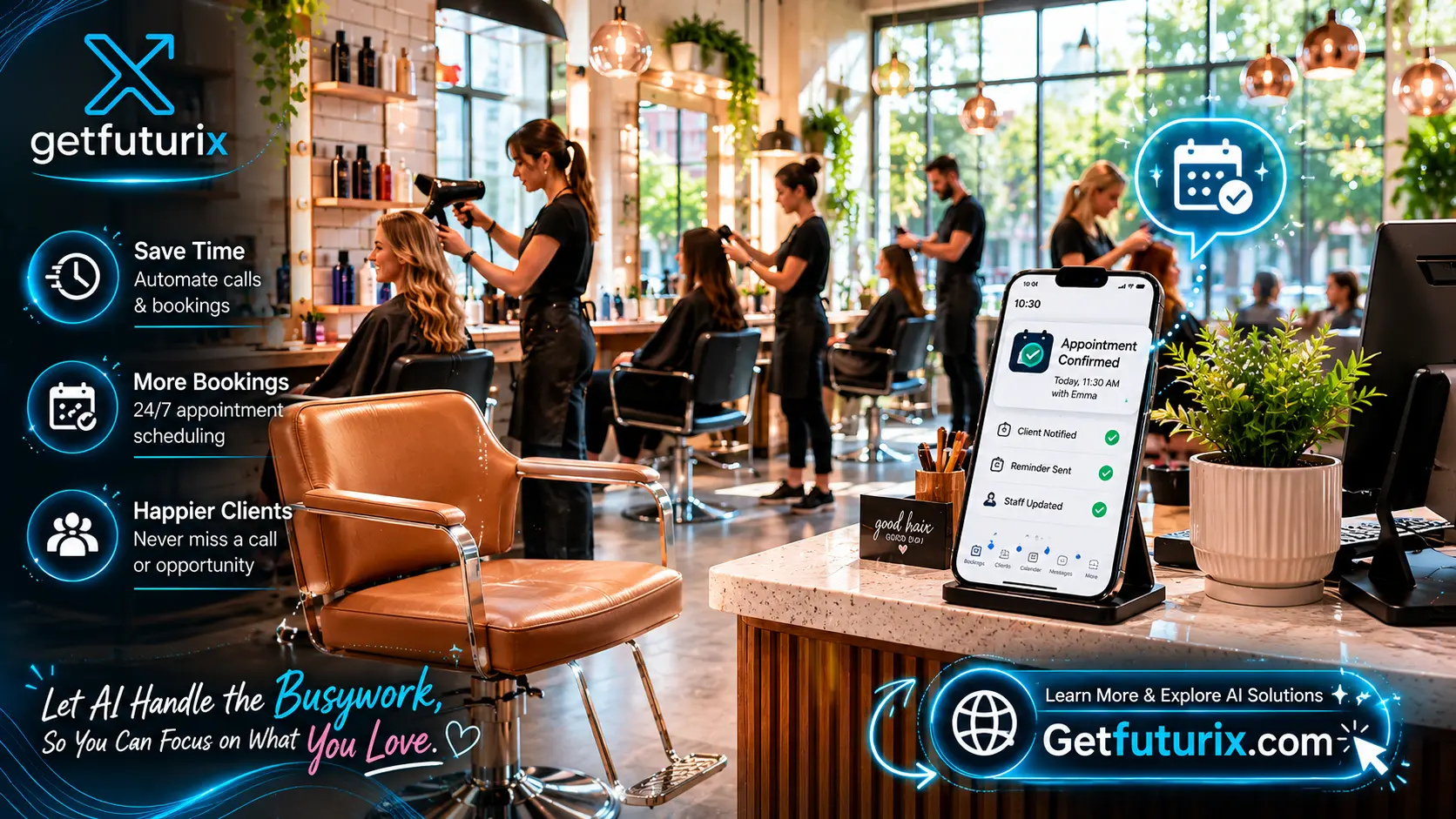
An empty chair costs you money every single minute it sits empty.
Not eventually. Right now, while you read this. A gap in the schedule, a no-show that never got backfilled, a client who tried to book at 9pm and gave up because nobody answered — that is real revenue walking out the door.
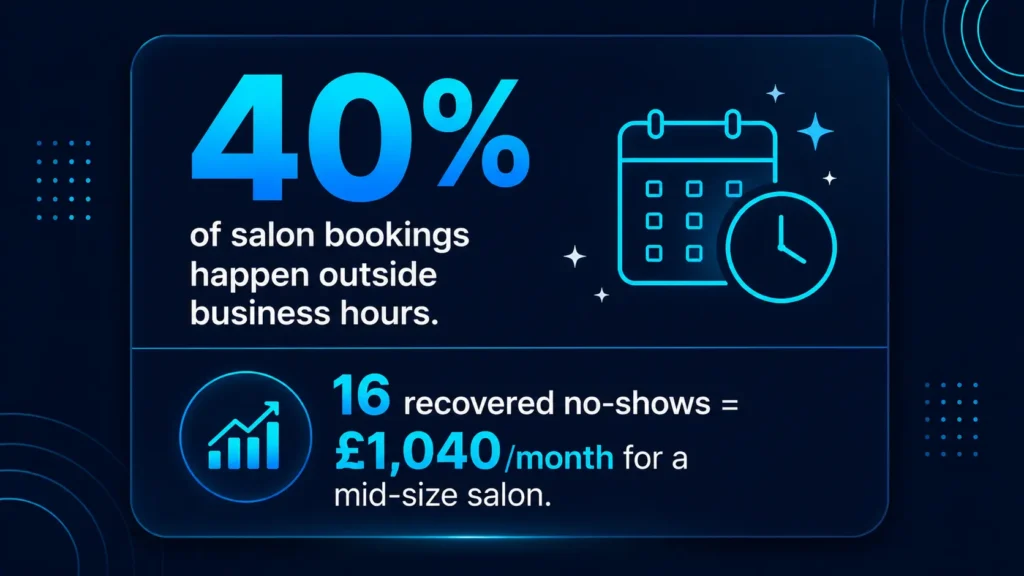
Here is the number that changes the conversation: 40% of salon bookings now happen outside normal business hours. If your booking system only works while someone is standing at reception, you are missing almost half your potential clients before they even become a booking.
This is where AI tools for salon owners genuinely earn their place. Not the marketing buzzword version. The kind that fills chairs while you sleep.
Table of Contents
The Real Cost of Empty Chairs and No-Shows
Let’s do the actual math, because vague promises don’t pay rent.
Take a mid-sized salon doing 150 bookings a month at an average ticket of £65. Recovering just 16 no-shows a month adds roughly £1,040 back into that salon. That is not a hypothetical. That is one salon’s real numbers, and most salons this size are losing at least that much every month without noticing.
Now add the after-hours gap. If 40% of bookings happen outside business hours and your salon has no way to capture them, you are turning away close to half of your potential new clients before your front desk even opens the next morning.
This is not a staffing problem. It’s an availability problem. And it’s exactly the gap AI tools for salon owners are built to close.
AI Receptionist for Salons: Booking While You’re With a Client
Here’s what a real AI receptionist for salons actually does, and it’s more capable than most owners expect.
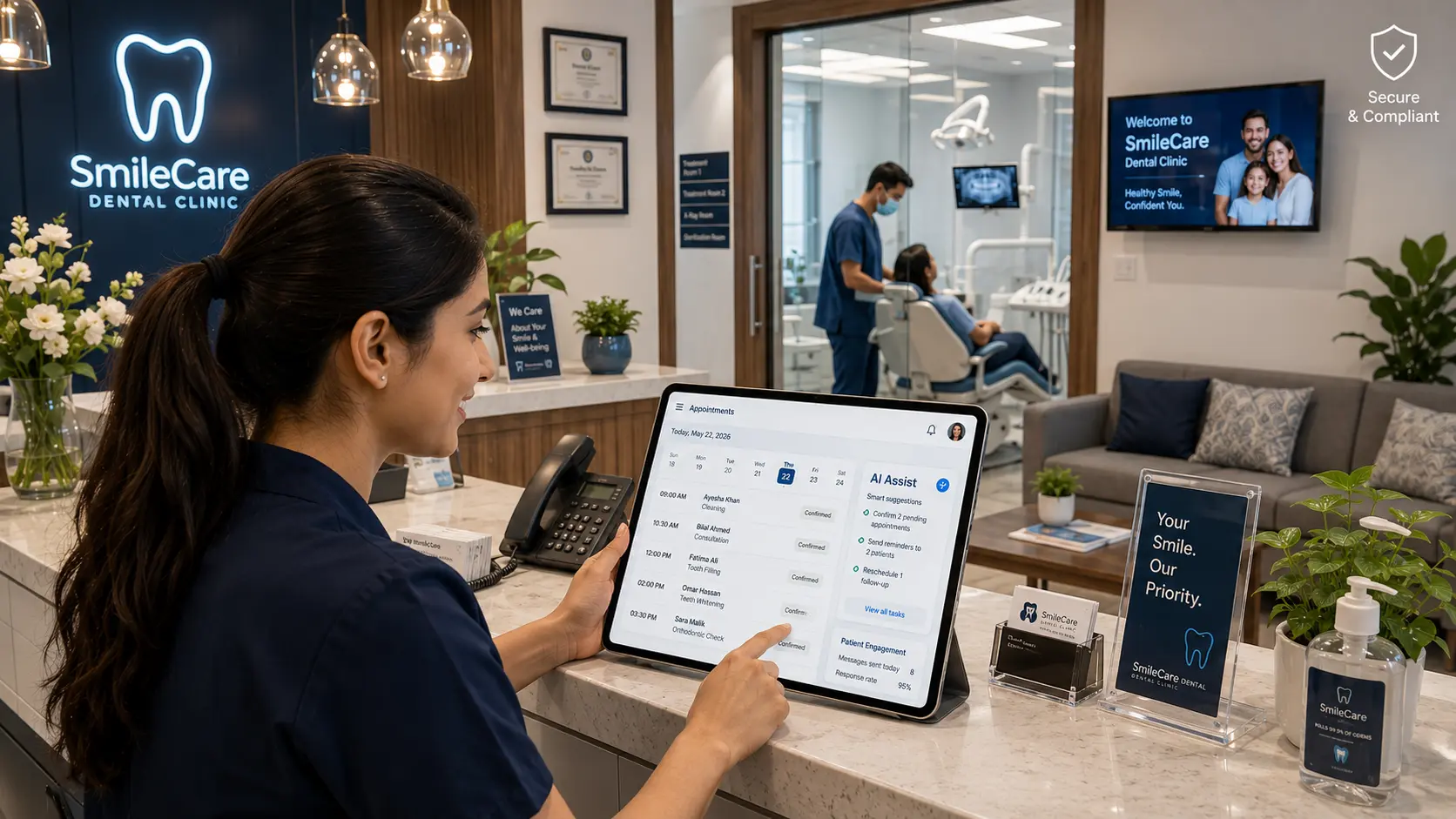
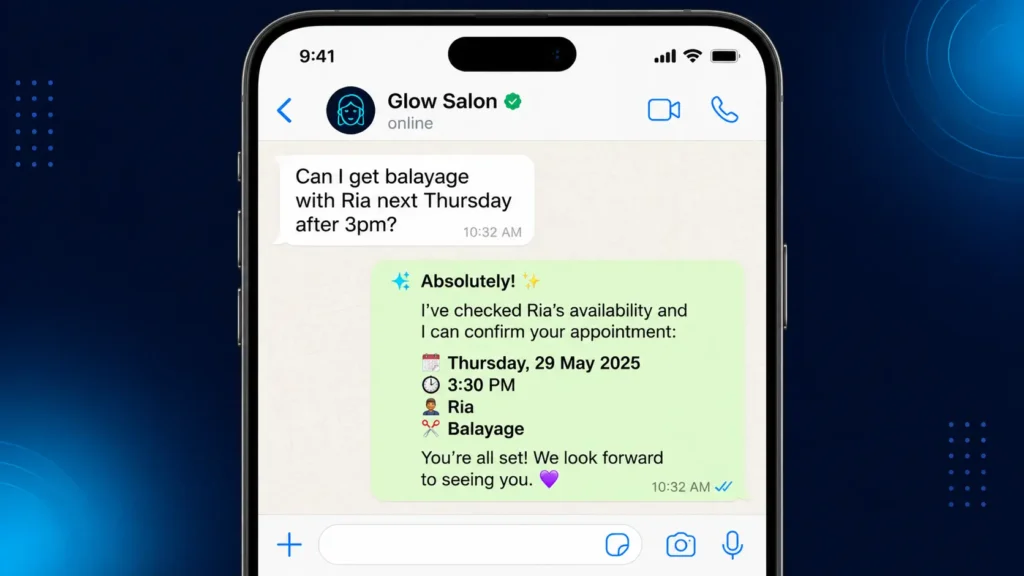
A client texts: “I want balayage with Ria next Thursday after 3pm.” The AI reads that exactly the way a human receptionist would — checks Ria’s real-time calendar, confirms the service takes the right amount of time, and books the slot. No scripted menu. No “press 1 for booking.” Just a normal conversation that ends in a confirmed appointment.
This matters because client comfort with this technology is already high. A 2025 Zenoti survey found 55% of salon clients are comfortable with AI receptionists — and that jumps to 71% for regular med-spa clients. The clients most accepting of this were aged 30 to 60, which covers the core demographic most salons serve.
The best tools in this category handle bookings, cancellations, and rescheduling across WhatsApp, SMS, and web chat — all funnelling into one shared inbox connected to your actual calendar. Your staff only step in for the complicated cases. Everything routine gets handled without anyone picking up a phone.
→ See also: AI Tools for Restaurant Owners: Save 5 Hours a Week
Salon Booking Software: What Separates Real AI From Marketing Hype
Here’s an uncomfortable truth about this category: “AI-powered” has become the most overused phrase in salon software marketing.
Every platform claims it now. Most of what gets sold as “smart scheduling” is just basic calendar conflict detection dressed up with a trendy label. Most “AI customer service” is a scripted FAQ chatbot that breaks the moment a client asks something slightly unexpected.
Real salon booking software does something specific: it understands natural language across multiple languages, checks live calendar availability in real time, and adapts the conversation instead of following a rigid script. If a tool cannot access your actual booking calendar and adjust to it live, the “AI” label is decoration, not function.
The good news is genuine tools do exist, and they are not just for large chains. Platforms like Booksy, Vagaro, Fresha, and Zenoti all integrate real AI receptionist features with live calendar sync. Ask any vendor one direct question before buying: does this book a real appointment from a natural conversation, or does it just collect a form? That single question filters out most of the hype instantly.
AI Scheduling for Salons: Predicting and Preventing No-Shows
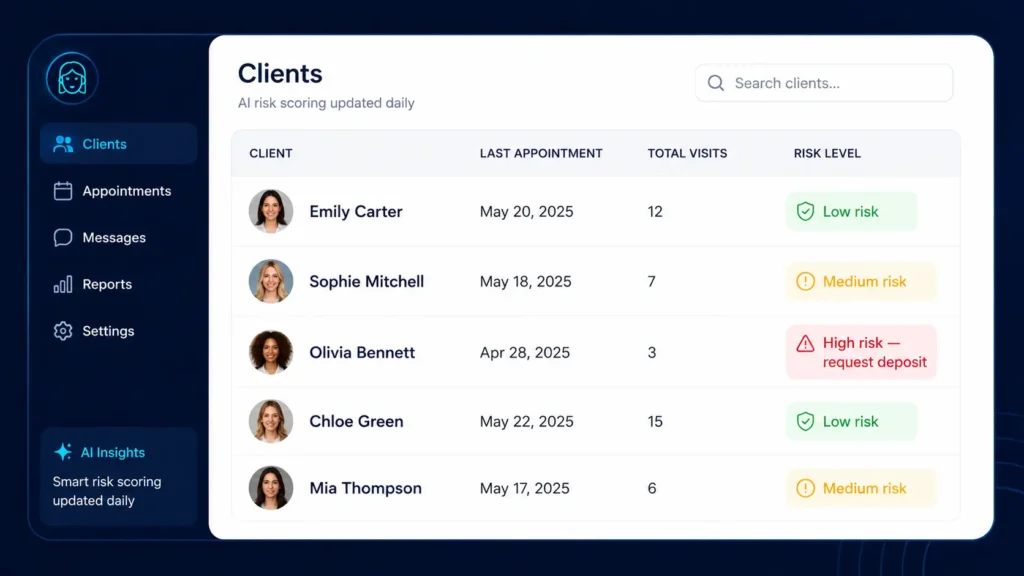
No-shows are not random. They follow patterns, and AI scheduling for salons is now genuinely good at spotting them before they happen.
The system looks at booking lead time, past client behaviour, and service type to flag which upcoming appointments carry higher no-show risk. A client who books a £150 colour appointment two months out with a history of last-minute cancellations gets flagged automatically. That flag can trigger a deposit request or an extra reminder — the kind of targeted intervention that a busy front desk never has time to do manually for every single booking.
This is where reduce no-shows salon strategies actually move the needle. Automated reminders alone help. But risk-based deposit requests, sent only to the bookings that actually need them, protect revenue without alienating your reliable regulars with unnecessary friction.
The reporting side matters just as much. Most salon software stores mountains of data — appointments, tips, cancellations, retail sales, rebooking rates — but never explains any of it. AI reporting tools turn that pile of numbers into an actual decision: maybe your lower-priced service is more profitable than your premium one because it takes less time and rebooks more consistently. That is the kind of insight a spreadsheet never surfaces on its own.
AI Marketing for Salons: Keeping Chairs Full Long-Term
Filling today’s schedule matters. Keeping clients coming back matters more.
AI marketing for salons now handles the repetitive part of retention automatically. A client who hasn’t visited in 30, 60, or 90 days can trigger a targeted win-back offer without you remembering to check who’s gone quiet. Personalised email and SMS campaigns generate from client history instead of a blank screen every month.
The numbers back this up clearly. Salons using AI-driven personalisation see average booking sizes increase by roughly 33%, and salons adopting AI broadly report 3 to 4% higher sales growth compared to those running everything manually.
For salons without budget for a dedicated marketing platform, ChatGPT for salon owners covers a lighter version of this well. Ask it to draft a win-back email for clients who haven’t booked in two months, or a set of Instagram captions for a new service launch. It won’t know your client list automatically — you still personalise the details — but it eliminates the blank-page problem that keeps most salon marketing from happening consistently.
→ See also: How to Use ChatGPT for Beginners: The Complete Guide
Comparing Salon Booking Platforms by Business Size
Not every platform fits every salon. Here’s how the main options actually stack up by business stage.
| Platform | Core Strength | Free Plan? | Best For | Starting Price |
|---|---|---|---|---|
| ChatGPT | Marketing drafts, admin writing | Yes | Solo stylists on a tight budget | Free / $20/mo |
| Fresha | Client-facing booking, marketplace discovery | Yes (basic) | Independent salons prioritising booking UX | Free tier / paid add-ons |
| Vagaro | All-in-one: scheduling, payroll, marketing | Trial only | Small-to-mid salons wanting breadth | ~$24+/mo |
| Booksy | Marketplace visibility + AI booking | Trial only | Salons wanting new client discovery | ~$30+/mo |
| Zenoti | Full platform: POS, CRM, AI receptionist, inventory | No | Multi-location salons and spa chains | Custom pricing |
The realistic starting point for most independent salon owners: begin with a booking platform that has genuine AI scheduling built in — Fresha or Vagaro cover most independent salons well — and add ChatGPT for the marketing writing you’re currently avoiding. Move to a full platform like Zenoti only once you’re managing multiple locations or need the deeper reporting a single-location tool doesn’t offer.
What AI Won’t Do for Your Salon
Let’s be honest about the edges of this, because oversold AI creates more frustration than it solves.
AI does not replace the trust a regular client has in their specific stylist. It can book the appointment. It cannot replicate the fifteen years of knowing exactly how someone likes their fringe cut. That relationship is still entirely yours.
A messy stack of disconnected AI tools creates more admin, not less. One tool for booking, another for email, another for reviews, another for inventory — that sounds flexible on paper and becomes a nightmare in practice. Pick platforms that connect to each other, not five separate logins.
Client data needs careful handling, especially health or allergy information. If your booking system stores patch test results or medical notes, confirm the platform is properly compliant with data protection rules in your region before rolling it out.
AI handles the repetitive booking admin extremely well. The craft, the relationship, and the judgment calls in the chair still belong entirely to you and your team.
Frequently Asked Questions About AI Tools for Salon Owners
Q: What are the best AI tools for salon owners just starting out?
A: For a solo stylist or small independent salon, start with a booking platform that has genuine AI receptionist features built in — Fresha has a usable free tier, and ChatGPT (also free) covers marketing writing and client communication drafts. Together these address the two biggest gaps: after-hours booking and the marketing you keep meaning to get to. AI tools for salon owners at this level don’t require a large budget to make a real difference.
Q: How much can AI scheduling actually save a salon in lost revenue?
A: The real math is significant. A mid-sized salon doing 150 bookings a month at a £65 average recovers roughly £1,040 a month just from preventing 16 no-shows. Add the after-hours bookings an AI receptionist captures — since 40% of salon bookings now happen outside business hours — and the combined impact on a salon’s monthly revenue is substantial, often justifying the software cost within the first month.
Q: Is AI receptionist technology something clients actually accept?
A: Yes, more than most salon owners expect. A 2025 Zenoti survey found 55% of salon clients are comfortable interacting with an AI receptionist, rising to 71% among regular med-spa clients. The key factor is how natural the interaction feels — tools that use natural speech patterns and remember client preferences get better reception than robotic, scripted ones.
Q: How do I tell if salon software’s “AI” is real or just marketing?
A: Ask one direct question: can it understand a natural request like “I want balayage with Ria next Thursday after 3pm” and book it against your live calendar — or does it just present a rigid dropdown menu with an AI label attached? Real salon booking software handles the first case. Most of the hype in this category is the second case wearing an AI badge.
Q: Can ChatGPT help with salon marketing even without dedicated software?
A: Yes. ChatGPT for salon owners is a strong, free starting point for win-back emails, Instagram captions, and service descriptions. It won’t automatically pull your client list or send campaigns on its own — you still handle personalisation and sending — but it removes the blank-page problem that stops most salon marketing from happening consistently.
Q: Do I need AI marketing tools if I already use AI for booking?
A: They solve different problems. AI scheduling for salons fills today’s calendar and reduces no-shows. AI marketing for salons brings back clients who have already gone quiet — a separate, ongoing revenue stream. Salons using AI-driven marketing personalisation see average booking sizes increase by roughly 33%, which makes it worth adding once your booking and scheduling gaps are under control.
One Empty Chair. That’s Where to Start.
You don’t need five new subscriptions and a total operations overhaul this week.
Look at your calendar right now. Find the gap — the after-hours booking you’re missing, the no-shows nobody flagged, or the client list that hasn’t heard from you in months. Fix that one gap first.
The AI tools for salon owners covered here work because they target a specific, measurable leak in your revenue — not because “AI” sounds impressive on a software brochure. Pick the leak that’s costing you the most. Fix it. Then move to the next one.
Want more practical AI guides built for small business owners? Browse our full library at GetFuturix.com.
Related articles on GetFuturix: