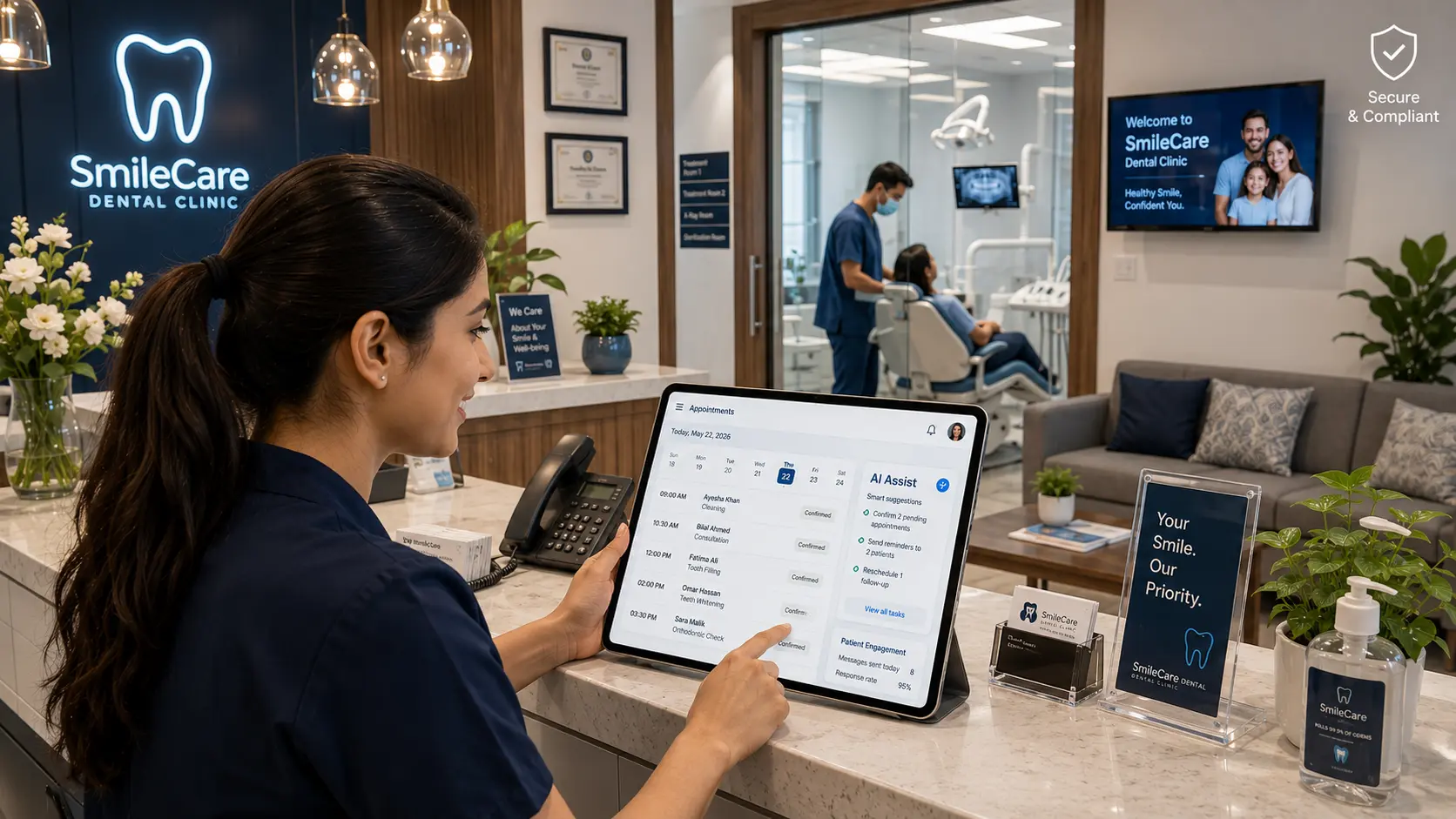
Your front desk missed four calls this morning. Two were new patients. Neither one called back.
That’s not a hypothetical. 38% of new patient calls to dental practices go unanswered, and 80% of people who reach voicemail simply never try again. For a solo practice or a small clinic, that’s not an efficiency problem — that’s a revenue problem, happening every single business day.
This guide covers AI for dentists and healthcare clinics the way it actually gets adopted in 2026 — starting with what pays back fastest, moving through what needs real clinical caution, and being straight about the compliance requirements most “best AI tools” content skips entirely.
Table of Contents
Why Front Office Comes Before Clinical AI
Most content about AI for dentists jumps straight to imaging AI, because it sounds the most impressive. That’s backwards for almost every practice.
The front office is where AI moves money fastest. Answering every call, filling last-minute cancellations, and reactivating patients who’ve gone quiet on recall — all of that affects this month’s production, not some future benefit. Clinical gains from imaging AI are real, but they show up slower on the books.
Roughly 73% of dental practices plan to adopt AI tools by 2027, and 35% already have as of 2026. The gap between early adopters and everyone still running everything manually is widening — and it’s widening fastest at the front desk, not in the operatory.
For most practices, the sensible order is: AI receptionist first, patient communication and recall second, clinical imaging AI third — once the front-office wins are already funding the rest.
AI Dental Receptionist: Answering Every Call
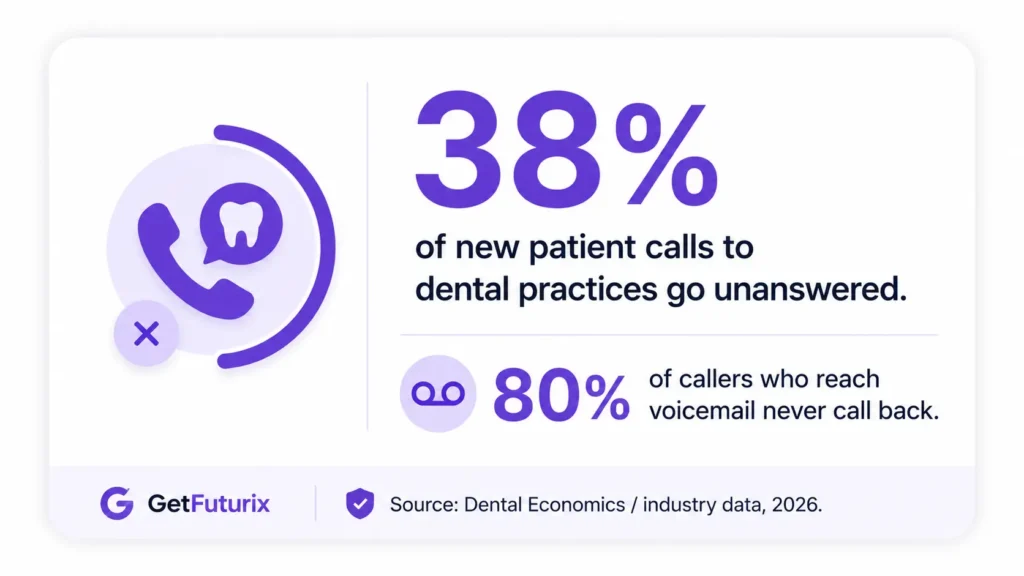
Here’s the number worth sitting with: practices miss 15 to 20 calls a week on average, and a large share of those are new patients who won’t try a second time.
An AI dental receptionist answers instantly, day or night, checks real-time schedule availability, books the appointment, and handles the routine questions — insurance accepted, office hours, what to expect at a first visit. Modern voice-first tools apply genuine dental scheduling logic too, distinguishing a routine cleaning slot from a crown-prep block that needs more chair time.
This isn’t basic voicemail with extra steps. The better tools integrate directly with practice management platforms like Dentrix, Eaglesoft, and Open Dental, so the booking actually lands in your real schedule — not a separate system someone has to reconcile by hand later.
→ See also: AI Tools for Salon Owners 2026: Book More Clients With Less Work
The honest tradeoff: front-office AI tools typically run $100 to $600 a month depending on features and call volume. For a practice losing even a handful of new patients weekly to unanswered calls, that cost is usually recovered within the first month.
AI Dental Scheduling Software: Fixing the No-Show Problem
No-shows and incomplete recall are quietly expensive in ways most practices don’t track closely enough.
Only 38% of practices have a systematic recall process, and just 22% follow up on a missed appointment within 24 hours. That gap compounds — a patient who falls through the cracks on a hygiene recall today is a patient who might not return at all.
AI dental scheduling software closes this gap by identifying patients who’d take an earlier opening, sending timely messages the moment a slot frees up, and automatically following up on overdue recall visits without anyone on staff having to remember to do it. The goal isn’t removing the human from scheduling. It’s making sure fewer patients get missed.
AI-assisted intake adds to this. When a new patient’s forms are reviewed automatically — medical history flagged, insurance verified, consent forms captured — the front desk simply confirms identity on arrival instead of re-entering everything by hand. One reported figure: roughly 18 minutes saved per new patient, which adds up meaningfully across a full week of new patient exams.
AI Dental Imaging Software: What It Does and Doesn’t Replace
This is the category that needs the most care, and it’s worth being precise here rather than vague.
The leading AI dental imaging software platforms — Pearl, Overjet, and VideaHealth among them — hold FDA 510(k) clearance as Class II medical devices for specific imaging indications. Pearl’s clearance (K210365) covers 2D imaging analysis. Overjet’s clearance (K222746) covers caries and CBCT assistance. VideaHealth received clearance in January 2024 for detection across more than 30 conditions.
Here’s the distinction that matters: FDA clearance is a fact. Vendor-reported outcome percentages are not the same thing. Some platforms report improved detection rates in their own case studies — those numbers come from the vendor, not an independent regulator, and should be read that way.
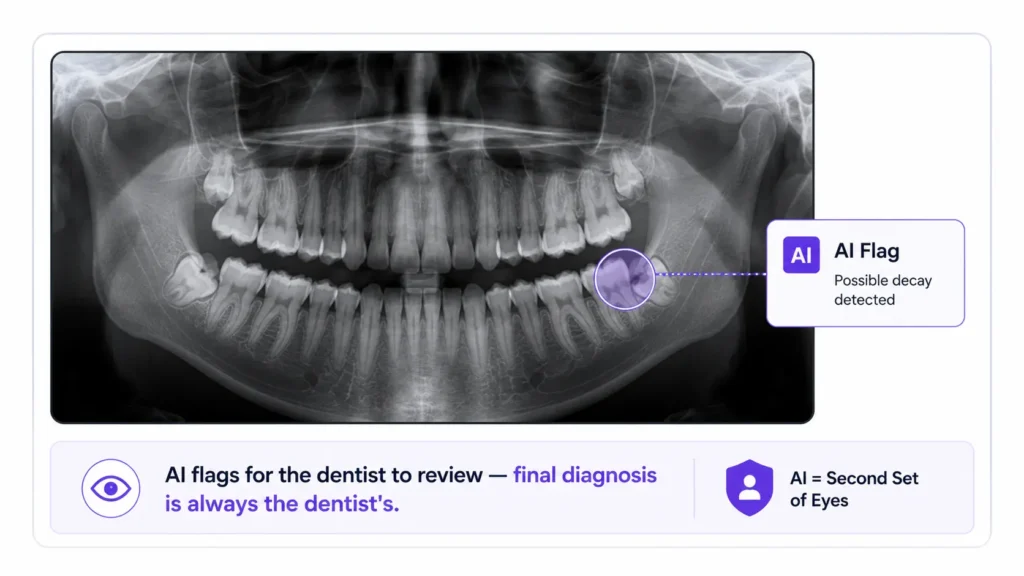
None of this changes the core clinical reality: the dentist makes every diagnosis and every treatment decision. AI dental imaging software flags possible findings as a second set of eyes on a radiograph. It does not diagnose, and using it outside its cleared indication is a real liability exposure that practices sometimes underestimate. Treat every AI-flagged finding as something to review, not something to accept.
This same principle extends to AI-assisted clinical documentation. Draft notes generated from a visit can save real charting time — but every note needs provider review and approval before it becomes part of the permanent patient record. AI can organize and summarize. It should never finalize a chart unsupervised.
HIPAA Compliant AI for Dentists: The Non-Negotiables
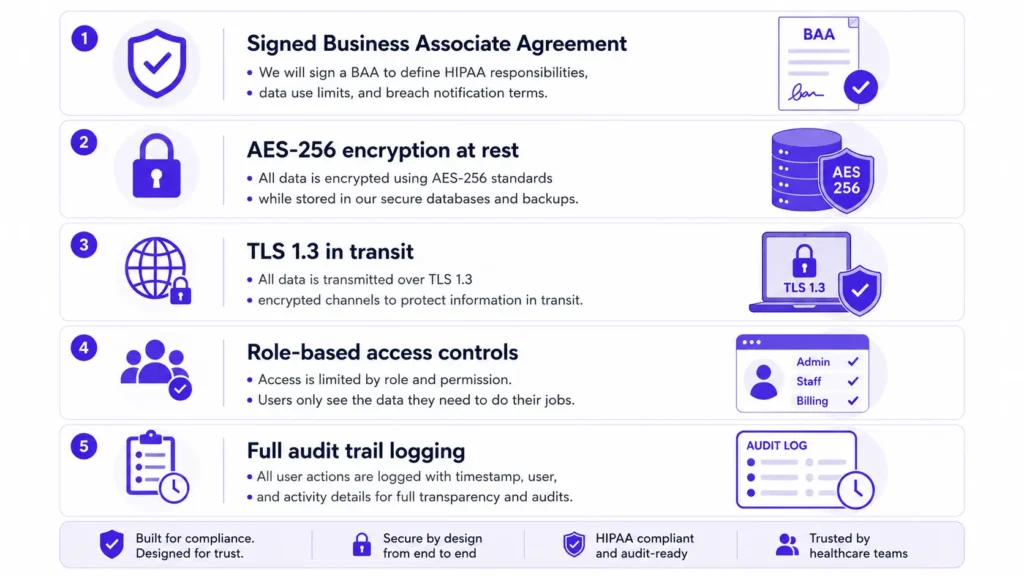
Every AI tool that touches patient data — voice agents, scheduling systems, intake platforms, imaging software — is legally considered a Business Associate under HIPAA. That single fact should shape every purchasing decision in this category.
Before any patient data flows to an AI vendor, confirm these five things without exception:
A signed Business Associate Agreement (BAA) is in place, including sub-processor flow-down if the vendor uses other companies behind the scenes. A vendor that hesitates on this question is telling you something important.
Encryption standards should meet AES-256 for data at rest and TLS 1.3 for data in transit — this covers call recordings, patient records, and stored text messages, not just the primary database.
Role-based access controls should limit exactly what each tool can see. An AI voice agent handling scheduling generally has no legitimate reason to access full clinical records.
Complete audit trails logging who accessed what patient data, and when — required for compliance and essential if a breach investigation ever becomes necessary.
Data minimisation — the AI system should collect and retain only what it actually needs to do its specific job, not everything available.
HIPAA compliant AI for dentists is not a marketing checkbox. It’s the baseline that determines whether a tool is even a legitimate option for your practice, regardless of how capable its features look in a demo.
Comparing Front-Office vs Clinical AI by ROI Timing
Here’s the honest sequencing breakdown most vendor content won’t give you directly.
| Category | Examples | Typical Cost | ROI Timing | Compliance Weight |
|---|---|---|---|---|
| AI receptionist | Voice-first scheduling agents, call answering | $100–$600/mo | Fastest — weeks | High (BAA + call recording) |
| Patient communication | Recall, reactivation, two-way texting | Often bundled | Fast — 1–3 months | High (PHI in messages) |
| Practice management AI | Scheduling optimisation inside existing PMS | Often included | Fast — natural entry point | Moderate (existing system) |
| Clinical imaging AI | Radiograph analysis, decision support | Typically quote-based | Slower — builds over time | Highest (FDA-cleared devices) |
| AI marketing tools | Blog drafts, social captions, ad copy | Free–$300/mo | Immediate, low stakes | Low (no PHI involved) |
For most solo and small practices, this table doubles as the adoption order. Start where the win is fastest and the compliance lift is manageable — front office and communication — then move toward clinical imaging AI once those earlier wins are already paying for the next step.
What AI Won’t Do in a Dental or Healthcare Practice
Being direct about the edges here, because this category attracts more overselling than most.
AI does not replace the doctor-patient conversation. Patients still need clinical guidance, time to ask questions, and a clear recommendation from the actual dentist. The technology should make that conversation easier to have, not less personal.
AI-generated clinical notes are drafts, not final records. Every provider needs to review and approve documentation before it enters the permanent chart — accuracy and completeness remain the clinician’s responsibility, always.
A vendor’s confidence is not a compliance guarantee. Verify the signed BAA yourself. Confirm the FDA clearance actually matches your intended use case. Off-label use of a cleared imaging tool is a real malpractice exposure, not a technicality.
AI genuinely helps with the repetitive, high-volume work — answering calls, filling schedule gaps, flagging findings for review. The clinical judgment, the diagnosis, and the relationship with the patient stay entirely with the people in the practice.
Frequently Asked Questions About AI for Dentists and Healthcare Clinics
Q: What is the best AI tool for a dental practice to start with?
A: Most practices see the fastest, most measurable return from an AI dental receptionist rather than clinical tools. Since roughly 38% of new patient calls go unanswered and most callers who reach voicemail never call back, front-office AI directly addresses a revenue problem that’s happening today. AI for dentists works best when adopted in order — front office first, patient communication second, clinical imaging AI third.
Q: Is AI dental imaging software safe and accurate enough to trust?
A: Leading platforms like Pearl, Overjet, and VideaHealth hold genuine FDA 510(k) clearance as Class II medical devices for specific imaging indications — that clearance is independently verified. However, AI dental imaging software is decision support, not a diagnostic replacement. The dentist reviews every flagged finding and retains full responsibility for the actual diagnosis and treatment plan. Vendor-reported outcome statistics should be read separately from FDA clearance status.
Q: What does HIPAA compliant AI for dentists actually require?
A: At minimum: a signed Business Associate Agreement with every AI vendor that touches patient data, AES-256 encryption at rest and TLS 1.3 in transit, role-based access controls limiting what each tool can see, complete audit trails of data access, and data minimisation so tools only collect what they genuinely need. HIPAA compliant AI for dentists isn’t optional — any tool handling patient information is legally a Business Associate under HIPAA regardless of how the vendor markets it.
Q: How much does AI cost for a dental practice or small clinic?
A: Front-office AI tools typically run $100 to $600 per month depending on call volume and features. AI marketing tools range from free up to roughly $300 monthly. Clinical imaging AI is usually quote-based and priced per chair or per location, so costs vary significantly by practice size. AI for small clinics 2026 budgets generally start with the front-office tier before scaling into clinical categories.
Q: Can AI replace front desk staff at a dental practice?
A: No — and that’s not really the goal. AI dental receptionist tools handle the routine, repetitive call volume that overwhelms a small front desk, particularly after hours and during peak call times. This frees staff for the higher-value work that genuinely needs a human — complex scheduling conversations, patient concerns, and the in-person experience. AI for healthcare clinics works best as support for existing staff, not a replacement for them.
Q: What AI tools help reduce no-shows at a dental or healthcare clinic?
A: AI dental scheduling software reduces no-shows through automated reminders timed for maximum response, waitlist management that fills last-minute cancellations automatically, and systematic recall follow-up for patients who haven’t returned. Given that only 38% of practices currently run a systematic recall process, this is one of the highest-impact, lowest-complexity starting points for a clinic just beginning to adopt AI.
Start With the Calls You’re Already Losing
You don’t need a full AI overhaul of your practice this month, and trying to do everything at once usually backfires.
Look at your own numbers first. How many calls does your front desk actually miss in a week? How many recall patients haven’t been followed up on in the last 24 hours? That’s where to start — not with the most advanced tool on the market.
AI for dentists and healthcare clinics works when it’s matched to where you’re actually losing time or patients, verified for real compliance before any patient data touches it, and rolled out one category at a time. Start with the front desk. Confirm the BAA. Build from there.
Want more practical guides on AI tools for small business and healthcare? Browse our full library at GetFuturix.com.
Related articles on GetFuturix:
- AI Tools for Salon Owners 2026: Book More Clients With Less Work
- AI Tools for Restaurant Owners: Save 5 Hours a Week
- How to Use ChatGPT for Beginners: The Complete Guide
This article covers practice-management and administrative software for dental and healthcare businesses. It is not clinical or medical guidance. Any clinical AI tool should be evaluated and deployed under the direct oversight of a licensed provider, in line with its specific FDA clearance and your practice’s compliance obligations.